by: Irene van Oorschot, Assistant Professor in sociology in the Public Issues and Imaginaries team at the Erasmus School for Social and Behavioral Research (ESSB), at the Erasmus University Rotterdam.
Foresters today work in contexts of extreme uncertainties, and confront intricate value conflicts in everyday practice. How do foresters envision the future, and is that even possible, given the waning of public funds for forest conservation and restoration and the intensification of global warming and associated threats to the forest?
Forests are spaces in which the past continues to materialize. For instance, a past of modern, plantation-style management to meet the demands of an industrializing, post-WW II nation struggling to achieve prosperity. But fieldwork with Dutch foresters also reveals the daunting presence of a future of escalating global warming, casting the necessity of resilient forests into sharp relief.
For forester Adam (pseudonym), the obligation to future-proof ‘his’ forests is one he feels acutely, particularly towards the foresters who will be managing the forest in the future. Speaking of making decisions, Adam often comes back to the refrain that “I never want to put my future colleagues with
their back against the wall. I want them to have choices, too.” One way to do this, Adam and
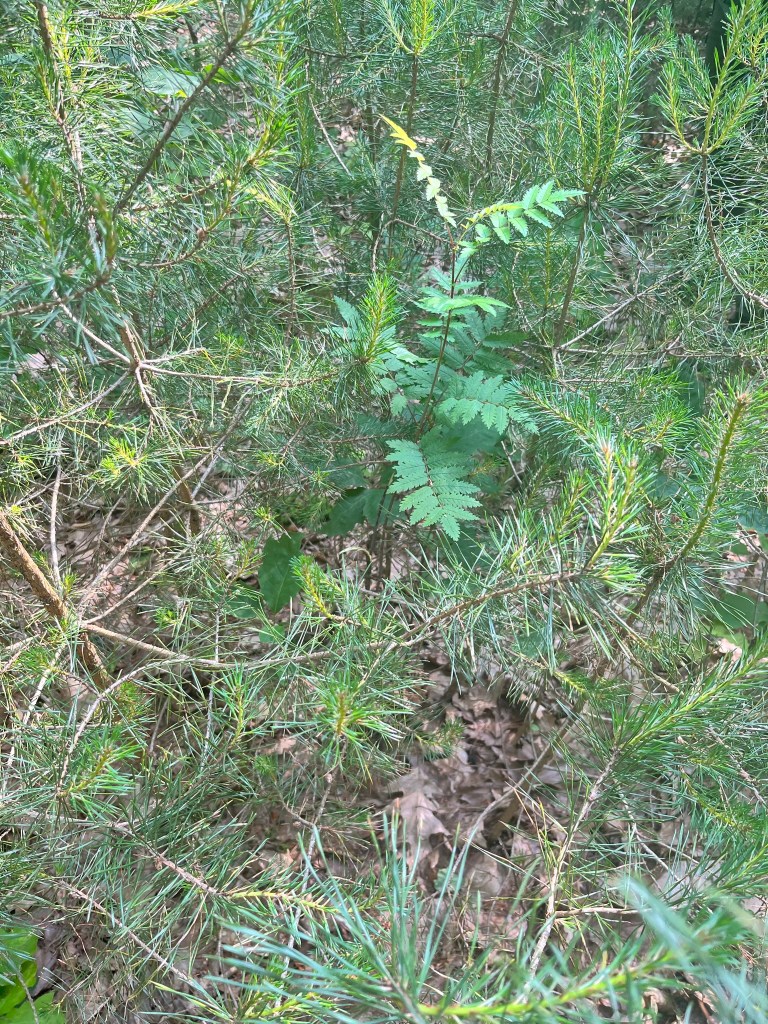
other colleagues tell me, is through mixing. Mixing ages and mixing species. A mixed age
stand combines trees in different phases of growth, with a younger generation getting ready
in the shade to grow into dominance when older trees are felled. And a forest mixed in
species can withstand the sudden appearance of a novel plague or pest that affects specific
tree species, or extreme climatic conditions that affect particular species more than others.
Last but not least: from a mixed forest it is possible to harvest different kinds and qualities of
timber, allowing foresters options in a volatile political climate and on ever-changing timber
markets. The uncertainties, after all, are not only climatic, but also financial. Mixing, for
Adam, is one way to make sure the future is not closed down, but will continue to be a space
of possibility. Mixing, in this context, is fixing.
But how to make choices if every choice opens up uncertain futures? And what if all these
choices, including the choice not to do something, always have consequences? Making
these decisions is the work Adam has to do – and he is making them in a situation of
structural underfunding, and at a climatic moment that existing projections of the future are growing
increasingly defunct. Perhaps his work is best understood as horizon work, to follow Adriana
Petryna’s conceptual language. Studying the fire emergency response practices of first responders, Petryna realized, with the participants in her study, that existing expectations
and projections of fires were growing increasingly defunct. ‘A new horizon is necessary’, one
of her participants remarked. Horizon work, for Petryna, is work of teasing out possibilities in
the present and in the wake of the realization that projection itself is growing increasingly
untenable.
At the edges of knowledge, then, we also find forestry professionals, policy-makers, and forestry organizations across Europe. With FORAGE, we explore how such horizons are taking shape across Europe’s various landscapes.
 FORAGE: FOREST ANTHROPOLOGY WORKING GROUP ON EUROPE AND BEYOND
Leave a comment