By Camila Del Mármol, Associate Professor at the Department of Social Anthropology (Universitat de Barcelona) working on the political ecology of forests and wildfires in the Catalan Pyrenees.
“It’s all forest now,” says Francesc as he drives around Alt Urgell in the Catalan Pyrenees. It was 2005, and he was working at the local government’s Cultural Heritage office. Born in the district’s capital, La Seu d’Urgell, he shared the concern of many locals still living in the area. The worst part, according to many peasants at the time, was the environmental laws that prevented them from, for example, collecting firewood from fallen trees or making any changes to the riverbanks. Many believed this situation led to the accumulation of debris that could cause fires or floods. Residents would describe the resulting situation – branches piling up, debris collecting between the trees – in terms of dirtiness and neglect. “They don’t know what life is like in the mountains,” Pere, who was born on a farm near the river—now converted into a rural cottage—told me, his smile wry.
Local residents of the Catalan Pyrenees don’t refer to their surroundings as “the woods,” but rather as “the mountain” (“aquí a la muntanya”). To the forest (bosc) you go to pick mushrooms, wood, or to hunt. You can also go hiking, but that is because you are a “pixa-pins” (literally, “one who pees on the pines”), meaning someone from an urban area. The wood is a place to go to, not the general concept to describe their “country”, as they would call it.
However, defining who qualifies as a local isn’t straightforward. The region is populated by people from various backgrounds—mainly from Catalonia—some born and raised in the mountains, others relocated from nearby cities in search of “a life closer to nature”.
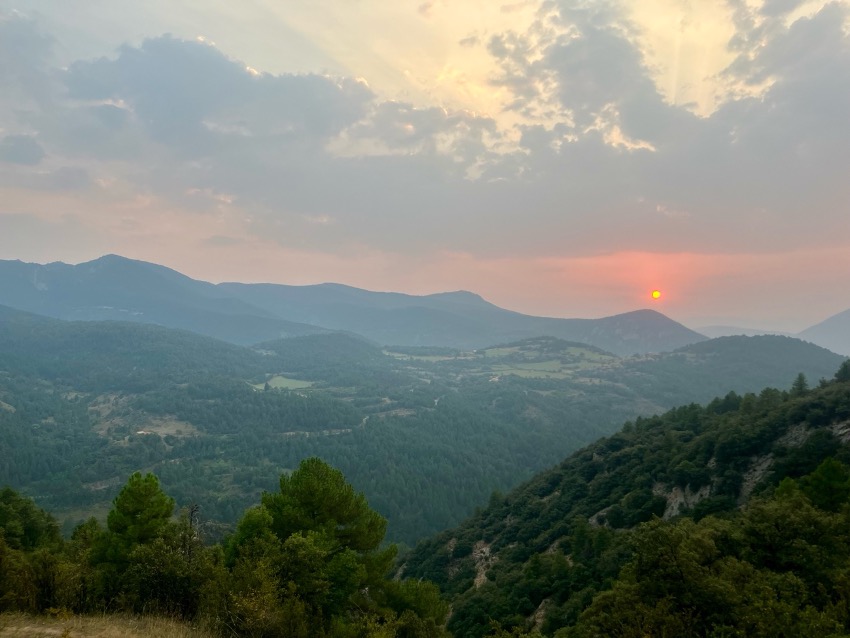
Different ideas about what makes for good care of the forest are not just a theoretical or aesthetic issue for locals. Their long standing local critiques of environmental law have become ever more urgent as global warming is heightening fire risks. In 2025, many Spanish regions suffered devastating wildfires, which burned up to 400,000 hectares between July and August. The intense heat waves revived memories and stories of changing weather. Although the fires were over 700 km away, on August 17th, the Pyrenees experienced burning sunsets as ash drifted through the air.
Spanish newspapers highlight the heroism of local residents battling wildfires: “Between flames and abandonment: the courage of the neighbors saves the villages” (Noticias del Pueblo, 17/08/2025). But in Petín (Ourense), authorities arrested a 61-year-old man accused of lighting a fire as wildfires approached. Around 100 people gathered to demand his immediate release: “He was making a counterfire because the flames were reaching some houses. It is unfair. That man has been working all week” (El País, 19/08/2025).
For many locals, the outbreak of these forest fires had something to do with the environmental laws that barred them from cleaning up the forest. Pere recalls how shepherds once burned gorse daily to keep the fields clear: “Nowadays the shit is all going down. You can’t even clean it. And what about the woods? (…) These days, you can hardly touch anything.” Yet, as the popular saying foretells evoking the need to “touch” the trees for taking care of the forest, the need to manage it purposefully: “The firewood either burns in the stove or burns in the forest”.
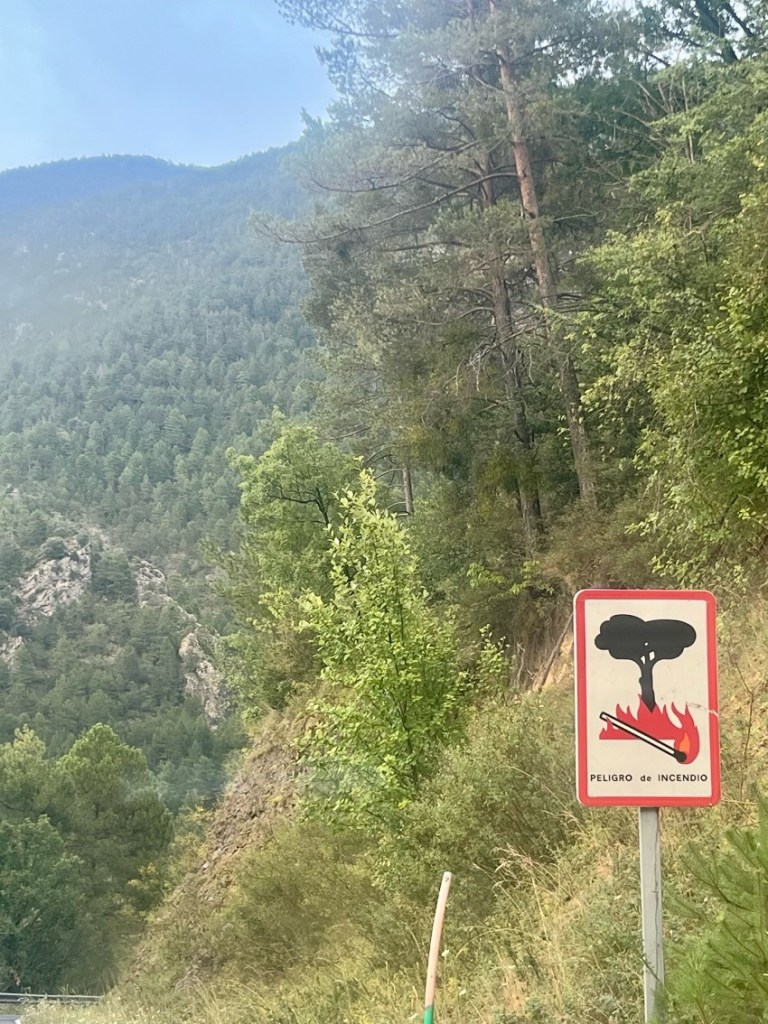
Local residents keep talking about filthy woods. In the Catalan Pyrenees, untouched forests are everywhere, and the traditional practice of controlled burns has become nearly impossible, tangled in a web of bureaucracy. This contradiction between local common senses and governmental logics is what we aim to explore in the Catalan case through the RURALEX project.
 FORAGE: FOREST ANTHROPOLOGY WORKING GROUP ON EUROPE AND BEYOND
Leave a comment