By: Jodie Asselin
To cite this post: Asselin, J. 2025. Green Frontiers. In, Roots for a Critical Forest Lexicon. https://foragenetwork.org/
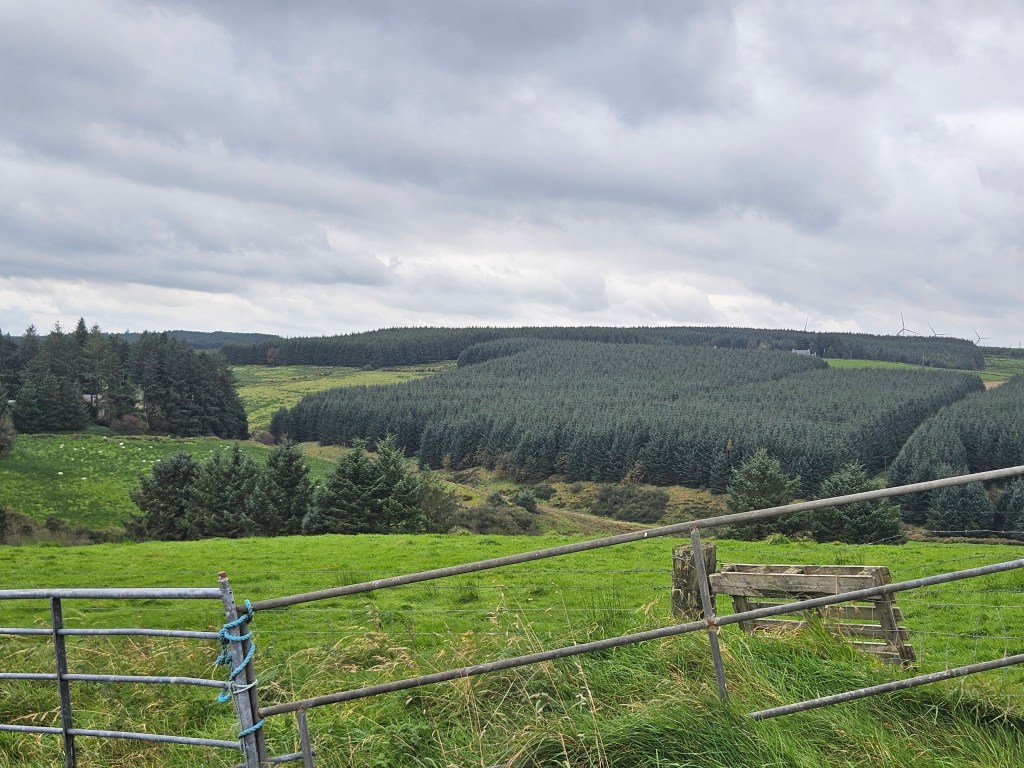
Image description: Upland conifer plantation in North County Cork, Ireland. Photo credit: Jodie Asselin
Big Question: How can we best understand the historical and political trends shaping the distribution of ‘green’ forest initiatives and their impacted communities?
In a 2025 article published in the journal Geoforum, Agata Konczal and I proposed that much contemporary green forest planning in Europe would benefit from a green frontiers lens (Konczal and Asselin, 2025). Green frontiers refers to the “process through which resources and places are conceptually and materially made and unmade, ordered, and controlled through apparently environmentally motivated projects” (Idem:3). In the article, we argued that the idea of green frontiers was a useful analytical tool that could draw much-needed attention to the mechanisms that were conceptually and, in some cases, materially reassembling many marginal European areas to better serve as blank slates for the green aspirations of others. In particular, we were interested in forest projects whose narratives were oriented around conservation, climate change, and biodiversity initiatives that required a broader forest and nature reimagining. Such is the case, for example, in Ireland’s marginal uplands, which are primed for conifer plantations through the mutually reinforcing presentation of tree crops as ecological saviors and local economic systems as depressed, marginal, and otherwise lacking (Asselin, 2025). Likewise, in Poland, where the ‘othering’ label of Eastern European dually serves to promise untrammeled forests and a people in need of development, forests can be cyclically remade to suit nearly any emerging need, including as a literal boundary (Konczal, 2020). This post briefly outlines the concept of green frontiers while more broadly cautioning against a loose, ill-defined articulation of forests as a catch-all category or a savior against human woes, without a deeper consideration of what forests might mean and imply at the local level.
The idea of green frontiers draws from the broader concept of resource frontier, where the discovery or invention of ‘new’ resources (Kelly and Peluso, 2015; Rasmussen and Lund, 2018) opens up sites to new types of territorial power including processes that work to manage risk, facilitate accumulation, and reconfiguring sovereignty (Cons and Eilenberg, 2019:3). Historically, frontiers are often entangled in colonial exploitations, where the desire to control resources and, subsequently, local populations, resulted in the rearticulation of vast regions as open for exploitation and profit making, primarily by non-locals. Within a resource frontier, territory, resource, and the rules that govern each are reworked, sometimes through violence, land seizures, and social interventions.
Green frontiers, we suggest, can echo these processes, particularly in their capacity to imaginatively rewrite the stories of land and people, often emphasising the potential of new or innovative resources to fill the imagined gap left by an otherwise undervalued or underperforming place. Building from rich work in the Global South, including Garcia and Fold’s (2022) application of the concept in their case study on the Colombian Amazon, we suggest that in this case, the concept focuses on the more ephemeral ‘resources’ of green discourse, including less tangible forest affordances such as biodiversity banks and carbon sequestration. In this way, landscapes can be discursively transformed into new types of resources. Here we speak of potential such as biodiversity banks, green refugia, renewable energy storage, biofuel suppliers, green investments, carbon sequestration sites, green borders, and climate change fixes. Very often, the materiality or presence of these shifts is not required for its discursive transformation — that is, the story is part of the product. The locations where such potential is imagined are often already highly impacted by various historical transformations; indeed, many were already frontiers in the classic sense. For example, in Romania, the emerging forest crisis is grounded in long-established frontier-specific processes. This time, such processes manifest through deregulation and reterritorialization (Vasile and Iordachescu, 2022), in which new green-friendly EU efforts to reduce fuelwood have detrimental impacts on populations still recovering from past waves of resource reorganisation (Iordachescu, forthcoming). In short, green frontier processes typically follow longstanding patterns of dispossession and can reproduce existing inequalities while simultaneously muting debate by applying a ‘green’ lens and its implied moral authority of environmentally necessary work.
In focusing on frontiers as a process rather than place, this lens draws particular attention to the mechanisms through which places are reimagined, for instance, through the (neo)colonial lens of ’emptiness,’ ‘waste,’ and ‘underdevelopment. Such concepts have long been tied to frontier formation and its continued mechanisms. An example is Brynne Voyles (2015) account of environmental privilege and wastelands surrounding US uranium mining, where strategic landscapes are portrayed as marginal, worthless, and pollutable to justify developments. More recently, however, such processes have also incorporated ideas of ‘greenness,’ ‘biodiversity,’ and ‘untouched-ness’ (Bridge, 2001; Braun, 1997; Murray, 2014). Here, marginal European areas, long the focus of alternating waves of interest and disinterest, are discursively shaped to justify, or even demand, intervention. Such work, like that involved in the production of wastelands above, first relies on acts of denial that emphasize the core emptiness of areas about to be intervened upon. This process has likewise been noted elsewhere through ideas such as unmapping (Tsing, 2003), discursive erasure (Bridge, 2001), undoing and unmaking (Singh, 2022; Rassmussen and Lund, 2018), emptying (Cons and Eilenberg, 2019), and reworking (Garcia and Fold, 2022).
Subsequent action, then, through policy, rezoning, regulation adjustments, and so forth, draws its apparent rationality from a basic moral reasoning, wherein this (newly established) place of limited value can sit in contrast to a “good-place” (Bridge, 2001). This new place is brought into being not exclusively through the colonially entrenched values of modernity and development, but through the establishment of ecological values and affordances. In such cases, the nuances of local meanings and the entangled relations of naturecultures are overlooked or understated, producing instead, for example, sites of green refugia, biofuel suppliers, green investments, and carbon sequestration sites.
The historical patterns of such placement are a primary concern here, as well-intentioned interventions are located in those places of least resistance, already discursively cleared and made ready. Indeed, our edited volume, The Anthropology of Political Forests (Asselin and Konczal, forthcoming) provides case studies from across Europe where such mechanisms are currently playing out, inlcuding the French countryside where the label of friche as scrub rather than forests in-the-making allows for different forms of intervention and development (Veitch), or in Spain, where the complicated history of eucalyptus plantations are equally tangled in discourses of greenness and social harms (Martinez-Reyes), and in Isreal/Palestine, where the establishment of new forests is a means of marginalising Bedouin communities in the Negev/Al Naqab desert (Grassiani).
The green frontier lens demands that the taken-for-granted affordances associated with the easy cultural capital of forests as inherently good, environmentally friendly, and positive places for community health be examined more closely, where forest interventions are understood as embedded in often historical patterns of unequal and sometimes exploitive relations. Employing an underexamined concept of forests can overshadow the often more complex realities on the ground, as well as the mechanisms by which existing powers can manipulate such discourses to increase their own profits, at times to the detriment of forests’ ecological systems. The green frontier lens asks us to examine the where, how, and why of forest interventions and to recognize the potential for troubling trends that can undermine the hoped-for positive outcomes of new forest interventions. This call is increasingly urgent, as the expectations placed on forests are mounting and formalized through well-meaning policies that must be implemented somewhere.
Jodie Asselin is an associate professor of anthropology at the University of Lethbridge.
Sources Cited:
Asselin, J. 2025. Troublesome ground: Farming trees and green policy in rural Ireland. University Press of Colorado.
Asselin, J., Konczal, A. (Eds). Forthcoming. An anthropology of political forests in Europe and Beyond. Manchester University Press.
Brynne Voyles, T. 2015. Wastelanding: Legacies of uranium mining in Navajo country. Univ Of Minnesota Press.
Braun, B., 1997. Buried epistemologies: the politics of nature in (post) colonial British Columbia. Ann. Assoc. Am. Geogr. 87, 3–31.
Bridge, G., 2001. Resource triumphalism: postindustrial narratives of primary commodity production. Environ. Plann. A: Econ. Space 33 (12), 2149–2173.
Cons, J., Eilenberg, M. (Eds.), 2019. Frontier assemblages: The emergent politics of resource frontiers in Asia. John Wiley & Sons, Hoboken
García, N.A., Fold, N., 2022. The coloniality of power on the green frontier: commodities and violent territorialisation in Colombia’s Amazon. Geoforum 128, 192–201.
Grassiani, E. Forthcoming. Productive landscapes of security: Planting forests in Israel/Palestine. Asselin, J., Konczal, A. (Eds) An anthropology of political forests in Europe and Beyond. Manchester University Press.
Iordachescu, G. Forthcoming. The forest falls upon us’: The moral economy of firewood in a European periphery. Asselin, J., Konczal A. (Eds) An anthropology of political forests in Europe and Beyond. Manchester University Press.
Kelly, A.B., Peluso, N.L., 2015. Frontiers of commodification: state lands and their formalization. Soc. Nat. Resour. 28 (5), 473–495.
Konczal, A., and Asselin, J. 2025. Exploring the green frontier within Europe’s recent forest Initiatives. Geoforum, 160, 1-10
Konczal, A., 2020. Why can a forest not be private? A post-socialist perspective on Polish forestry paradigms–an anthropological contribution. Forest Policy Econ. 117, 102206.
Martinez-Reyes, J.E. Forthcoming. De-eucaliptizing a plantationocene: Moral ecologies of Galician forests. Asselin, J., Konczal A. (Eds) An anthropology of political forests in Europe and Beyond. Manchester University Press.
Murray, L.T., 2014. Plenary lecture: What is land? Assembling a resource for global investment. Royal Geographical Society 39, 589–602.
Rasmussen, M.B., Lund, C., 2018. Reconfiguring frontier spaces: the territorialisation of resource control. World Dev. 101, 388–399.
Singh, D., 2022. ‘This Is All Waste’: Emptying, cleaning and clearing land for renewable energy dispossession in Borderland India. Contemporary South Asia 30 (3), 402–419.
Tsing, A.L., 2003. Natural resource and capitalist frontiers. Econ. Pol. Wkly 38 (48),5100–5106.
Vasile, M., Iordachescu, G., 2022. Forest crisis narratives: Illegal logging, datafication and the conservation frontier in the Romanian carpathian mountains. Polit. Geogr. 96, 102600.
Veitch, A. Forthcoming. Permanent scrub, never forest: The politics of abandoned farmland in France. Asselin, J., Konczal, A. (Eds) An anthropology of political forests in Europe and Beyond. Manchester University Press.
 FORAGE: FOREST ANTHROPOLOGY WORKING GROUP ON EUROPE AND BEYOND
Leave a comment