By: Erella Grassiani
To cite this post: Grassiani, E. (2026) Arboreal Nationalism. In: Roots for a Critical Forest Lexicon, https://foragenetwork.org/?p=392
Big Question: What role do forests and trees play in nationalist ideologies and practices?
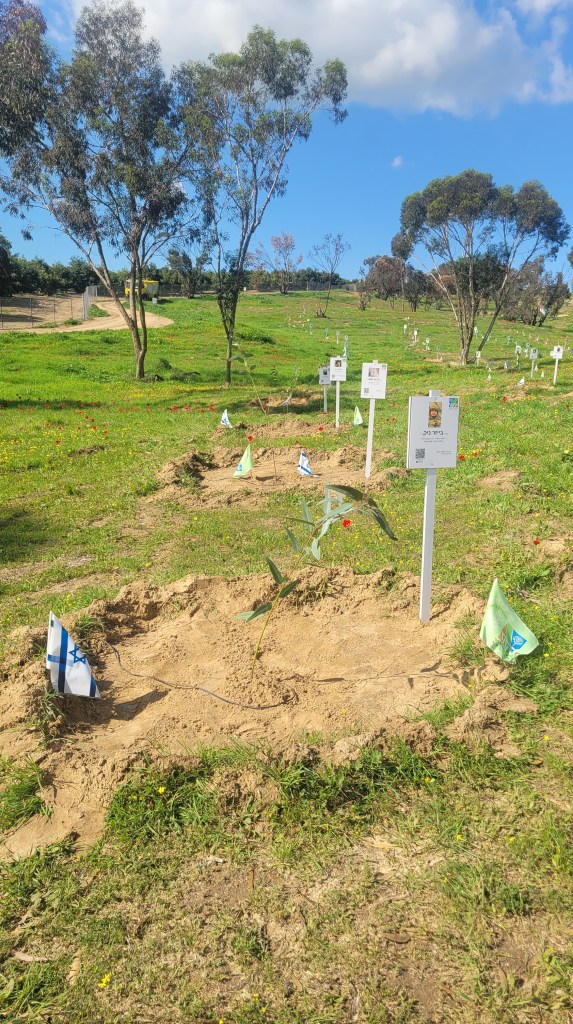
Image description: A photograph of trees planted in the Sword of Iron forest in the South of Israel. Photograph by author.
Imagine an olive tree, 150 years old, deeply rooted in Palestine. This olive tree survived tree cutting during the Ottoman Empire, which desperately needed wood for its railroads (El-Eini 1999). It saw British soldiers walk by it in the time of the Mandate. As it came under Jordanian control, it witnessed the Israeli War of Independence, or the Naqba, meaning “catastrophe,” in which over 750.000 Palestinians were displaced, and 400 Palestinian towns, villages, and cities were destroyed. In 1967, the land on which the tree stands, in which it grew its deep roots, was occupied by Israel and became known as the West Bank (of the river Jordan). The Palestinian farmer who lives on these lands today finds it increasingly difficult to reach the tree, which she deeply cherishes for its fruits, but mostly for its roots, which connect her and her family to the soil (Abufarha 2008).[1] Today in 2026, Israeli forces threaten to cut the tree down for what they term to be “security reasons”; the tree blocks the access road to an Israeli settlement, and the military is afraid “terrorists” will find a hiding place behind its big and twisted trunk (e.g., Al Jazeera 2025). In reality, this tree and many like it are cut down to force the farmer to abandon her land so Israeli settlers can build a new settlement (Burke 2024; Braverman 2009). Such settlements are illegal under international law and have been used to take over Palestinian land in the West Bank for decades.[2]
This olive tree and the grove it is part of are not just silent bystanders to the events around them. Through the significance these trees hold for the people who tend them and enjoy their fruits, as well as their role as an obstacle to nationalist expansion, they actively participate in the historical, political, and nationalist processes that unfold in their vicinity, both violent and non-violent. In a forthcoming chapter, published in the edited collection The Anthropology of Political Forests (Asselin and Konczal forthcoming) I identify these practices as arboreal nationalism, or nationalism that is enacted through the instrumentalization of trees and forests in diverse forms. I place these practices in Israel/Palestine, where they vary in form from tree destruction, for example, to occupy land and evict populations that are perceived as not belonging to the imagined nation, to tree activism in which trees and/or forests are the tools through which belonging to a national group is imagined and even celebrated. Importantly, it also encompasses afforestation efforts from Israel’s early years, aimed at concealing the remnants of destroyed Palestinian villages and preventing the return of their inhabitants’ villages (Bronstein Aparicio 2014), as well as more recent tree-planting initiatives, often promoted as ‘green’ activities, used to take over and ‘Judaize’ land in Israel’s periphery.
Nationalism, more generally, is the attempt to imagine and practice ‘the nation’ as a relatively homogeneous and bounded political and ontological unit; historically, it has often been imagined as overlapping with particular states, e.g., in 19th-century Europe. But the overlap between ‘nation’ and ‘state’ is never complete and without friction. Crucially, nationalism often makes strong territorial claims, suggesting that a nation can and should be tied to a particular territory. Across contemporary politics, nationalist efforts to imagine and sustain a cohesive national community frequently coincide with environmental concerns (Marguiles 2021; Hamilton 2010; Conversi & Hau 2021). Marguiles (2021) defines this as eco-nationalism, and Conversi & Hau (2021) refer to it as green nationalism.
In colonial contexts, the concept of green colonialism has helpfully addressed how ecological and environmental concerns are incorporated into (neo)colonial processes. This is, for instance, the case when nature reserves are established while displacing Indigenous communities living on this land, as they are perceived as destroying the “real nature” in the park (Blanc 2022; Ferdinand 2021). The concept extends to broader green projects where colonial land occupations are hidden beneath ecological rhetoric, a dynamic noted in Israel/Palestine (Klein 2016; Sasa 2023). In a similar vein, Grove (1996) identifies green imperialism, whereby Global North countries undertake the saving of nature in the Global South, “before ecologically irresponsible local inhabitants end up destroying it” (Blanc 2022:10). The historical role of botanical gardens and forestry as colonial instruments for controlling and managing colonized territories is also well documented (Scott 1996; Grove 1996; Davis & Burke 2011).
Through the conceptualization of arboreal nationalism, I advance this existing scholarship on how natures and nationalism intersect. Arboreal nationalism takes trees and forests as its starting point for analysing nationalist processes and is therefore more tightly focused than approaches that emphasize “nature” or “the environment” in general. Moreover, while arboreal nationalist practices can include discourse about environmentalism and ecology, it is not limited to activities and ideas that are concerned with the preservation of nature and ecological issues. What distinguishes arboreal nationalism from eco- or green nationalisms or colonialism is, further, that it includes not only violent nationalism, but also forms of activism instrumentalizing trees for nationalist causes.
In a forthcoming chapter titled Arboreal Nationalism: Afforestation for the Jewish nation-state in Israel/Palestine, I lay out how I use arboreal nationalism to analyze instances in which states, but also other, non-state actors, use trees and forests as part of their nationalist ideologies and practices. While arboreal nationalism can be read narrowly as “a sense of place that is shaped by the presence and cultural significance of trees” (Depper 2007) or as a form of distant relationality described as a “long-distance arboreal nationalism” (Darieva 2025), my approach treats it as a politically inflected repertoire that includes nationalist practices in which trees and forests are instrumentalized through planting, uprooting, preservation, and cutting them down.
Arboreal nationalism, importantly, demonstrates the purposefulness of states and other groups organizing themselves around tree-centered issues. In my forthcoming work, I highlight three core elements central to this conceptualization: (1) how arboreal nationalism reveals the exclusionary consequences of tree-centred practices within the nation-state; (2) the central role of colonial ideas about forests and forestry in shaping arboreal nationalism; and (3) the increasing prominence of nationalist practices by non-state actors, which makes studying non-state actors essential (Trouillot, 2001).
One form of arboreal nationalism I examine in my work concerns the tree planting initiatives by different state, semi-state, and non-state organizations. One example consists of afforestation initiatives by the Jewish National Fund or KKL-JNF. This organization, founded at the beginning of the 20th century to buy land in Palestine for the creation of the Jewish State, has planted and taken care of all of Israel’s forests since 1948. Studies have firmly established that this organization is complicit in the displacement of Palestinians and the erasure of Palestinian life from the Israeli (Jewish landscape) (e.g. Davis, U 2023; Peace Now 2020; Iraqi 2021; Roth and Rosen 2022). In my work, I focus on its most recent activities in the south of Israel, where a new forest is being planted to commemorate those who were killed on October 7th by Hamas and the soldiers who were killed during the war in Gaza.[3] I show in my work how this forest, which is called the Sword of Iron forest after Israel’s military operation in Gaza, is part of a nationalist quest by a semi-state organization with a strong Zionist, nationalist ideology. The newly planted forest confirms and reproduces the rootedness of Jews in Israel by symbolically planting trees in the name of victims who are perceived as having died for the sake of the Jewish nation-state.
Planting trees is also actively used by settler organizations to affirm Jewish presence on Palestinian land. One such organization I studied organized a Tu B’shvat event (Jewish holiday celebrating trees) on an empty plot in East Jerusalem (which was occupied and annexed by Israel) where trees were planted under the guise of Zionist sustainability and greening.
In a context marked by a settler-colonial imposition of particular ideas of the nation – Zionism – and ongoing resistance against the destruction of Palestinian life, the concept of arboreal nationalism underscores how forests and trees may figure as instruments both in forms of colonial land grab through their deliberate destruction or through tree planting initiatives – but also brings into view how forests and trees hold the promise of endurance and survivance (sumud) for oppressed communities.
Erella Grassiani is associate professor at the Department of Cultural Anthropology, University of Amsterdam.
Works Cited
Abufarha, Nasser. 2008. ‘Land of Symbols: Cactus, Poppies, Orange and Olive Trees in Palestine’. Identities 15 (3): 343–68. https://doi.org/10.1080/10702890802073274.
Al Jazeera. 2025. ‘Israeli Military Uproots Thousands of Palestinian Olive Trees in West Bank’. Al Jazeera. https://www.aljazeera.com/news/2025/8/23/israeli-military-uproots-thousands-of-palestinian-olive-trees-in-west-bank.
Blanc, Guillaume. 2022. The Invention of Green Colonialism. John Wiley & Sons.
Braverman, Irus. 2009. ‘Planting the Promised Landscape: Zionism, Nature, and Resistance in Israel/Palestine’. Natural Resources Journal 49 (2): 317–65.
Bronstein Aparicio, Eitan. 2014. ‘Zochrot – Most JNF – KKL Forests and Sites Are Located on the Ruins of Palestinian Villages’. Zochrot – Most JNF – KKL Forests and Sites Are Located on the Ruins of Palestinian Villages. https://www.zochrot.org/publication_articles/view/55963/en?Most_JNF__KKL_forests_and_sites_are_located_on_the_ruins_of_Palestinian_villages.
Burke, Jason. 2024. ‘Why Settler Intimidation of West Bank Farmers Is about Far More than the Olive Harvest’. World News. The Guardian, December 11. https://www.theguardian.com/world/2024/dec/11/why-settler-intimidation-of-west-bank-farmers-is-about-far-more-than-the-olive-harvest.
Conversi, Daniele, and Mark Friis Hau. 2021. ‘Green Nationalism. Climate Action and Environmentalism in Left Nationalist Parties’. Environmental Politics 30 (7): 1089–110. https://doi.org/10.1080/09644016.2021.1907096.
Darieva, Tsypylma. 2025. ‘Planted Flags? The Political Life of Trees and Arboreal Patriotism in Armenia’. In Education and the Politics of Memory in Russia and Eastern Europe. Routledge.
Davis, Diana K., and Edmund Burke, eds. 2011. Environmental Imaginaries of the Middle East and North Africa. Ohio University Press. https://library.oapen.org/handle/20.500.12657/51086.
Davis, Uri. 2023. The JNF/KKL: A Charity Complicit With Ethnic Cleansing. https://www.memopublishers.com/publications/jnf-kkl-charity-complicit-ethnic-cleansing/.
Ferdinand, Malcom. 2021. Decolonial Ecology: Thinking from the Caribbean World. John Wiley & Sons.
Grove, Richard H. 1996. Green Imperialism: Colonial Expansion, Tropical Island Edens and the Origins of Environmentalism, 1600-1860. Cambridge University Press.
Hamilton, P. 2010. ‘The Greening of Nationalism: Nationalising Nature in Europe’. Environmental Politics 11 (2): 27–48. https://doi.org/10.1080/714000611.
Hechter, Michael. 2000. Containing Nationalism. OUP Oxford. Klein, Naomi. 2016. ‘Let Them Drown’. Politics & Economics. London Review of Books, June 1. https://www.lrb.co.uk/the-paper/v38/n11/naomi-klein/let-them-drown.
Iraqi, Amjad. 2021. ‘The JNF Is No Innocent Charity’. +972 Magazine, March 4. https://www.972mag.com/jnf-germany-palestinians-forests/.
Margulies, Morgan. 2021. ‘Eco-Nationalism: A Historical Evaluation of Nationalist Praxes in Environmentalist and Ecologist Movements’. Consilience, no. 23: 22–29.
Peace Now. 2020. ‘KKL-JNF and Its Role in Settlement Expansion – Peace Now’. https://peacenow.org.il/en/settler-national-fund-keren-kayemeth-leisraels-acquisition-of-west-bank-land.
Roth, Daniel, and Maya Rosen. 2022. A Progressive Jewish Response to the Discriminatory Policies of KKL-JNF. https://www.breakingthesilence.org.il/inside/wp-content/uploads/2022/01/%D7%93%D7%95%D7%97-%D7%A7%D7%A7%D7%9C.pdf.
Sasa, Ghada. 2023. ‘Oppressive Pines: Uprooting Israeli Green Colonialism and Implanting Palestinian A’wna’. Politics 43 (2): 219–35. https://doi.org/10.1177/02633957221122366.
Trouillot, Michel‐Rolph. 2001. ‘The Anthropology of the State in the Age of Globalization: Close Encounters of the Deceptive Kind’. Current Anthropology 42 (1): 125–38. https://doi.org/10.1086/318437.
[1] The tree described here and the farmer are imaginary figures that are, however, based on many real stories of olive trees and Palestinian farmers in the West Bank.
[2] As of 2024 there were 141 settlements formalized by the Israeli government and over 200 outposts set up by settlers, but considered illegal also under Israeli law https://peacenow.org.il/en/settlements-watch/settlements-data/population.
[3] I use the concept ‘war’ here to point to the larger context of war, of which the genocide in Gaza is a fundamental part. However, when speaking about Israeli soldiers who died since October 7, the more encompassing concept of ‘war’ is more appropriate.
 FORAGE: FOREST ANTHROPOLOGY WORKING GROUP ON EUROPE AND BEYOND
Leave a comment