By: Dr. Jodie Asselin, Associate professor of environmental anthropology at the University of Lethbridge, Canada.
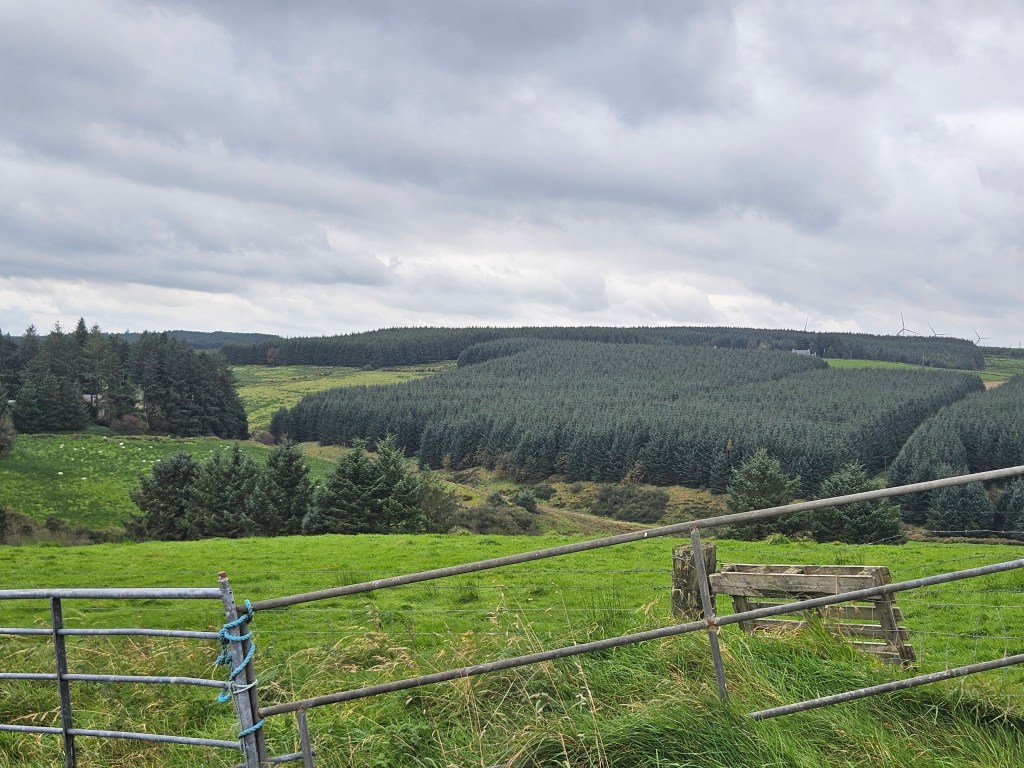
“Once the land is planted, it’s gone.” This line was repeated to me often while working with small upland farmers in north County Cork, Ireland. I have been conducting research in the area since 2017, and at the time of writing, I have just returned from five months of fieldwork, during which the same line was again repeated. When asked what it means, to be ‘gone’, the response was predictably similar, “I mean, it’s gone.”
Obviously, land has not disappeared, but this transformation from something to nothing, from some-place to no-place, felt by many (though not all) farmers, has occupied my mind for some time now. This is an area of Ireland where, since the mid-20th century, particularly from the 1970s onward, rough upland farmland has slowly been transformed into landscapes of non-native conifer plantations. Sometimes smaller than 5 acres, these individual ‘forests’ have transformed this upland area into an extensive forested landscape, with some parishes being as much as 50% forested, according to locals.
Early work in this area led me to understand that once a field was planted with trees, it was transformed into a homogenous ‘non-place’, like any other. Moreover, because the nature of upland forests and plantation systems means tight planting, even-aged stands, and often deep ditch-dike systems to help drain wet land, they are often challenging to enter. Most farmers also work with contractors to plant and manage their forests, many of whom lack the equipment or capacity to serve as active managers beyond the initial planting. Thus, the land is removed from cultural memory, physical engagement, or skilled management.
While exceptions to this pattern exist, I am drawn to the tension between what was and what might still be. This interest is heightened when those working in the forest industry told me that Ireland needs to “build a forest culture.” Whose, I wondered? Moreover, from where would that emerge?
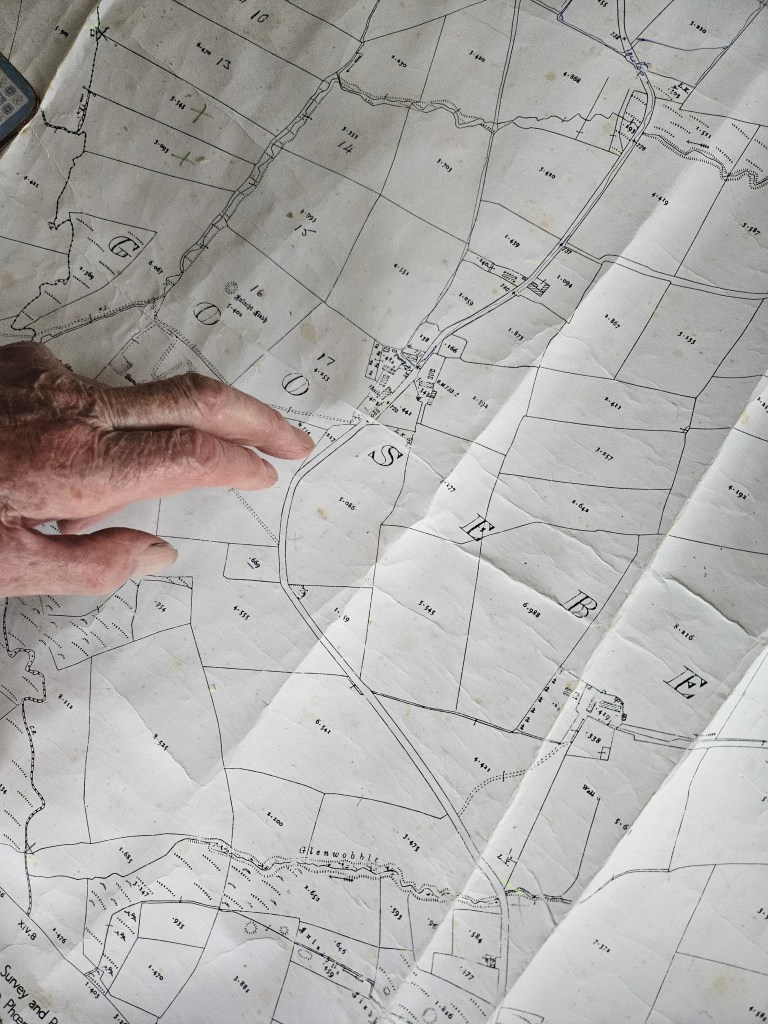
My most recent project involved collecting oral histories from farmers about the fields they had planted with conifers. Mapping stories and knowledge of fields before trees, I asked, for example, for field names and field stories. I asked about the occupants of old buildings now abandoned, about the archaeological sites now planted around, about wells and springs, and about their uses and, sometimes, their healing powers. I asked about rights-of-way, trails used by children to school, grazing uses, turf cutting, and, in general, the stories of place that came to mind when looking at satellite images, taking walks through farms, or while sitting at kitchen tables drinking tea and looking out windows at forested valleys. “What did this view look like before?” I would ask.
What emerged was a thick tapestry of dynamic rural landscapes. In this area, most land planted with trees was the most marginal on a farm, a troublesome piece where the subsidies for planting might bring in money for a 15 or 20-year period, with hopes that one day the timber would have worth despite the legal and financial obligation to replant and keep the land forested. That was another part of being ‘gone’; the land use could not shift again, now designated as forest under its legal land type category in perpetuity.
Such stories help me understand what is meant by the idea that “the land is gone,” and they might also help track the potential opportunities and pitfalls of building a forest culture in Ireland. Moving forward, we will add to our story maps through folk tales, land descriptions from reports now held in archives, old maps, and cultural anchors that help us understand what a forest might be if viewed outside the dominant influence of plantation thinking. During interviews, landowners were also asked about the future, to imagine what they might like to see and what they might be worried about seeing. Often, it was difficult for people to consider a different type of forested landscape.
Ultimately, while aiming to record and make locally accessible the intimate stories of place that might no longer be shared otherwise, this work asks what it would take for such forests to be someplace once again?
— this research is in part funded by the Canadian Social Sciences and Humanities Research Council (SSHRC)

 FORAGE: FOREST ANTHROPOLOGY WORKING GROUP ON EUROPE AND BEYOND
Leave a comment