By: Malcolm Sanger, PhD candidate in Communication Studies at McGill University, Montréal. Malcolm studies the histories, infrastructures, and labours of making forests and trees in Canada.
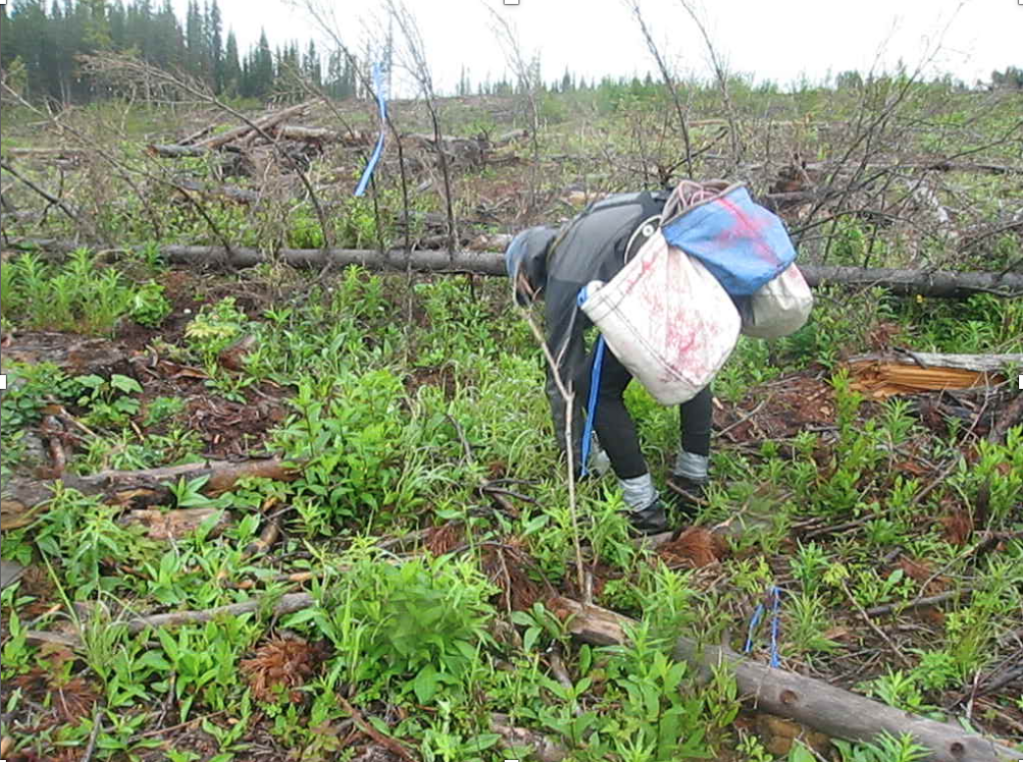
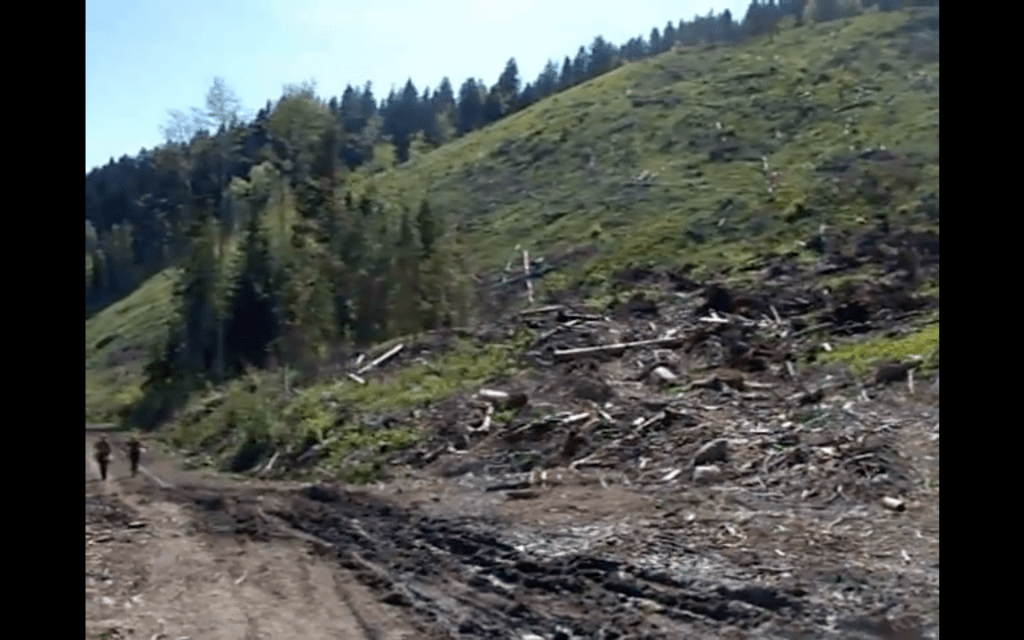
“When you finish your piece, I want you to walk through the treeline and follow the flagger to the next cut-block,” our crew boss told us. It was nearing the end of the day. We were planting trees somewhere near the intersection of the borders of northwestern Alberta, northeastern British Columbia, and the southern edge of the Northwest Territories, in Canada. Eight hours earlier, a helicopter had let us off in a swamp, not turning off its rotors as we scrambled out, and releasing a sling full of tree boxes nearby. We were finishing planting one clear-cut and our crew boss was hoping we could walk to another small cut-block nearby. The route would be much faster if we walked as the crow flies, through the treeline and the unlogged forest. The plan was that the first ones through would take the GPS and drop plastic, fluorescent flagger behind them as they went so that others could follow, almost like leaving a trail of bread crumbs in a fairy tale. Max and I were the last to finish planting our land: we gathered our water bottles, day bags, and shovels and stuffed them into our planting bags which were strapped around our waists.
We found the first plastic flag, but then no more. It’s fine, we said to one another, we know the direction, and we’ll find another soon. Maybe they got blown around a bit. It was a sparse, wet, northern spruce forest, perhaps planted some decades ago by people not unlike ourselves. We went on for a while, but the flat uniformity of the forest made it difficult to tell one direction from another. Eventually we were deep enough to have that horrible moment when, all at once, your feet, brain, and heart stop—we had no idea which way we’d come from and which way we were going. Doubt and panic. I wasn’t even confident I could remember the direction of the last step I’d taken. That there were two of us made things better and worse: we hid our fear from each other, but maybe that had gotten us this far in the first place. I started to rehearse how we would spend the night out here. We decided to pick a direction that seemed promising and go as straight as possible. Eventually, we came to an old logging road, flooded with mud. We went left and found ourselves back where we’d started, on the cut-block we’d just finished planting. We started with the first flag again but couldn’t find the second again. We persisted in cutting through what we now realized was a slice of forest between one cut-block and a logging road. Now we could hear a helicopter approaching. It hovered low, and the supervisor of our camp leaned out the window, waving her arm to direct us down the logging road, right, to the rest of our crew, and our worried crew boss. “I was thinking about bears,” he said, offering us some crushed cookies in a bag.
The Canadian sensibility is, in Northrop Frye’s rendering, “less perplexed by the question ‘Who am I?’ than by some such riddle as ‘Where is here?’”1 The frontier as the formative American settler environment relies on a visibility or visuality that was and is frustrated in Canada by the presence and quantity of trees. The settler environmental relation that Frye and Margaret Atwood diagnose in Canada and Canadians involves the contradiction of an overwhelming emptiness – a lack of lack – in the wilderness that surrounds. The early settler-writer in the backwoods exists in a state of “frightening loneliness” to which nature is “blankly indifferent.” This experience and these representations of these “margins” are ones central to the settler psyche in Canada, and contrast with the perspective of Indigenous peoples and locals, who experience these spaces and places very differently. But this settler environmental relation also remakes these environments: the “indefinite vagueness” of the forest is perhaps amplified in a near-monoculture plantation.2 But getting lost is also a core part of ethnography: Peter van Wyck, writing about a similar area of Canada, says,
The fragments, pieces, reflections that constitute this work are a commentary on a place and a time from which I am, and remain, a bewildered stranger. A term of neither grandiosity nor self-negation, bewilderment, to become bewildered… is of course not the same as being lost, although it is related… This bewilderment to which I refer… is a kind of movement of going astray, of confronting an ambiguously located wilderness, perhaps inside, perhaps outside, or both. It is to be unsettled, off the path, but not unmoored completely (this would be precisely the phantasy of ‘going native’). 3
My ethnographic experience of getting lost while working in the silvicultural industry in northwestern Canada is in relation to these histories of nature and environment, and to the project of anthropological or ethnographic research. I was bewildered by the forest after the clear sightlines of the cut-block. The land Max and I walked was marked by histories of forestry, organized by the particular Canadian settler capitalist political economy. Ethnography, too, in its unsettling, is organized by similar histories. The road we found was “de-activated,” but a helicopter came looking for us. Despite our experience of the margins of it, we are part of the perpetuation of this possibly renewable industry, a circular economy, and the cultural import of this settler relation to forests. In getting lost, we felt some of these histories.
Endnotes
1 Frye, The Bush Garden, 220.
2 Frye, The Bush Garden, 138–39; Atwood, Survival: A Thematic Guide to Canadian Literature. For some primary sources, see: Moodie, Roughing It in the Bush; Traill, The Backwoods of Canada.
3 Van Wyck, The Highway of the Atom, 5.
Bibliography
Atwood, Margaret. Survival: A Thematic Guide to Canadian Literature. 1st McClelland & Stewart ed. M & S, 1996.
Berland, Jody. “Space at the Margins: Critical Theory and Colonial Space after Innis.” In Harold Innis in the New Century: Reflections and Refractions, edited by William Buxton and Charles R. Acland. McGill-Queen’s University Press, 1999.
Frye, Northrop. The Bush Garden. House of Anansi, 1971.
Innis, Harold. The Fur Trade in Canada: An Introduction to Canadian Economic History. 1930; University of Toronto Press, 1970.
Moodie, Susanna. Roughing It in the Bush. Maclear & co, 1852.
Traill, Catharine Parr. The Backwoods of Canada. Edited by Michael A. Peterman. Centre for Editing Early Canadian Texts. C Knight, 1836.
Van Wyck, Peter C. The Highway of the Atom. McGill-Queen’s University Press, 2010.


Leave a Reply