By: James Palmer
To cite this post: Palmer, J. (2026) Vegetal Labour. In: Roots for a Critical Forest Lexicon, https://foragenetwork.org/?p=454
Big question: How can we address intensifying efforts to enrol plants as energy sources in capitalist economies?
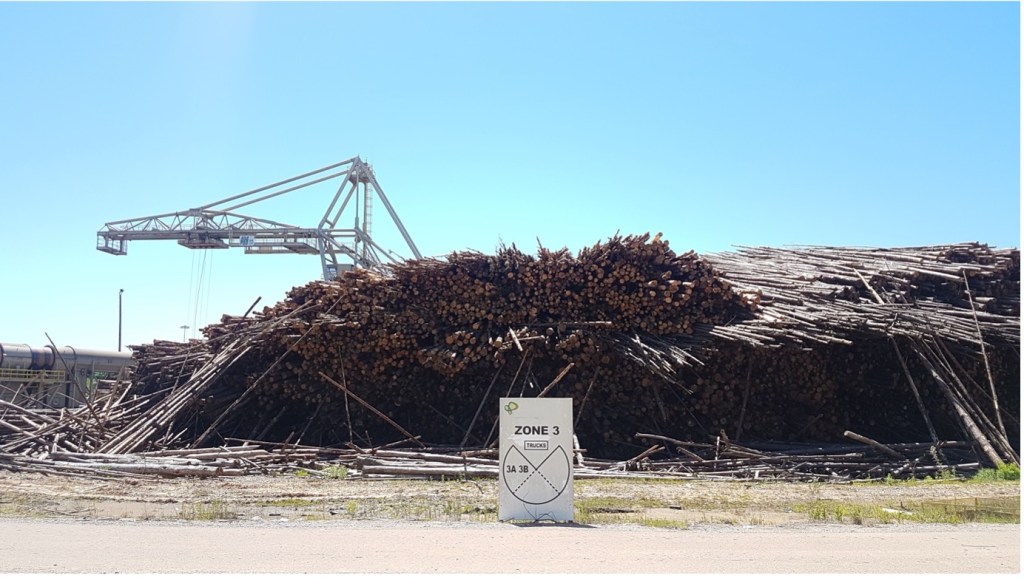
Image description: A large pile of tree stems—largely loblolly pine—awaits processing into compressed wood pellets at a manufacturing plant in Mississippi. In 2024, the US exported more than 10 million tons of wood pellets to countries across Europe and Asia, almost all bound to replace coal in electricity generation.
The global energy sector is in the grip of a modern “bioenergy boom” (Lohmann, 2021). Across many of the world’s largest and fastest growing economies, the industrial-scale enrolment of plants as sources of renewable, apparently carbon-neutral alternatives to coal, oil and gas is steadily increasing. The scope of this boom encompasses a liquid transport biofuel sector using crops like sugarcane, oil palm, maize and wheat, as well as the growing production of compressed wood pellets for combustion in power stations in contexts as far flung as the UK, the Netherlands, Japan and South Korea (International Energy Agency, 2024; Palmer, 2021). Looking to the future, the use of genetically engineered agricultural crops to produce tens of billions of litres per year of so-called sustainable aviation fuels is central to lofty government and industry visions for achieving net zero aviation by the middle of this century (International Air Transport Association, 2024). Perhaps most ambitiously of all, moreover, massive-scale bioenergy with carbon capture and storage—or BECCS for short—is routinely positioned as essential to preventing a global temperature overshoot beyond 1.5 or 2 degrees Celsius in global greenhouse gas (GHG) emissions scenarios endorsed by the UN’s Intergovernmental Panel on Climate Change (IPCC, 2018; Malm and Carton, 2024).
For protagonists, modern bioenergy forms one part of a broader, emergent bioeconomy which, as Kristin Asdal and colleagues have argued, is often heralded rather uncritically for its supposed capacity to drive growth in ever more “innovative, sustainable, responsible and environmentally friendly” ways (Asdal et al., 2023: 2). On the surface, the idea of a bioeconomy promises to reduce society’s dependence upon finite supplies of fossil resources, both for energy generation and for wider industrial activities, in favour of ostensibly carbon-neutral alternatives which should theoretically never run out. Core to these promises is the innate regenerativity of the plant kingdom.
In my new book, titled Power Plants: Bioenergy, Vegetal Labour and the Politics of Productivity (Palmer, 2026), I shine a critical light on the role of such ideas in facilitating the rapid global growth of modern bioenergy systems. I show how these developments gloss over important political questions—questions pertaining not just to the scope of sustainable and desirable futures for agriculture, forestry, or even plant lifeforms writ large, but also to the future shape and cadence of human social and economic activities in a supposedly post-fossil fuel era.
Strikingly, prevailing scientific, commercial and political discourses around the desirability of modern bioenergy pay only minimal attention to the actual plants which are being enrolled to help produce it. Instead, these discourses typically foreground the similar material properties of fossil fuels and biomass-based fuels as finished energy carriers, framing biofuels as superior to other renewables because they can be stockpiled like coal, oil or gas, and deployed on demand when solar and wind power aren’t readily available (Chatti et al., 2017). Moreover, these discourses also suggest that biofuels are inherently carbon neutral, presuming that GHG emissions generated by burning those resources will inevitably be offset by the growth of new plants in the future.[i] Given these moorings, dominant understandings of modern bioenergy tend to essentialise the actual crops and trees being used to produce biofuels as mere “feedstocks”—in other words, as passive inputs whose capacity to regenerate and regrow constitutes a remarkable “free gift” of nature that it would make little sense not to optimise and put to productive use (Boyer et al.,2023; see also Battistoni, 2025).
Much like highly influential accounts of the nonhuman world as a vast repository of natural capital whose value can be located in the provisioning of diverse ecosystem services (Kareiva et al. 2011; Helm 2015), reductive framings of crop plants and commercially-grown trees as mere feedstocks for bioenergy production detract our attention from deeper questions. These include questions about what our energy system—indeed, what our economy as a whole—should ultimately be for, how we should measure its progress and improvement over time, and indeed how we might live and work otherwise with vegetal lifeforms. To highlight these deeper questions, my book proposes that we should understand plants as active contributors to value production in the bioenergy sector; in short, as vegetal labourers rather than mere free gifts for capital to use.
On one level, the idea vegetal labour is intended as a provocative antidote to what I see as the highly conservative concepts of ecosystem services and natural capital.[ii] It’s an uncomfortable idea, of course; we are used to presuming that labour requires forethought, preconception, intentionality, and skill of various kinds—all attributes we tend to think of in human-centric terms.[iii] However, insisting on bioenergy as a product of vegetal labour is not to make any claim about the ‘true’ nature of labour as such. Rather, it is to foreground the inherent contestability of the working arrangements that humans enter into with plants across diverse agricultural and forest-based contexts, as well as the end goals those arrangements are set up to serve. In short, the point is to contend that simply because we can use plants as a large-scale alternative to fossil fuel resources, this doesn’t mean that we should, or that doing so should be regarded as automatically virtuous.
Paying closer attention to “the work that plants do” (Ernwein et al., 2021) as they photosynthesise, grow and sequester carbon dioxide, I would suggest, offers potentially radical challenges to prevailing understandings of crops and trees as little more than passive feedstocks furnishing our economies with a renewable, supposedly sustainable alternative to fossil fuels. To begin with, an attunement to the time plants actually take to grow might encourage more patient and respectful attitudes towards the making of fuels, inducing reflection on the broader cadence of our relationships with energy resources of all kinds. Secondly, the non-linearity of plant growth, comprising more and less dynamic periods both seasonally and over longer timeframes, might prompt us—as Kate Neville has recently speculated—to challenge capitalism’s reification of continuously expanding production and consumption with an equal embrace of stability, rest and idleness as valuable and important states in their own right (Neville, 2024). Thirdly, if—following plant philosopher Michael Marder (2015)—plant growth is understood as inherently unpredictable and eventful, rather than as a formal process of pre-scripted expansion, this might give us pause to reflect anew on the possibility of cultivating relationships with energy whose purpose is itself open-ended (rather than prescribed in advance as subservient to the imperative of perpetual economic growth). Finally, through their very indifference to notions of use or purpose, plants could incite us finally to reject what Cara Daggett (2019) has deftly exposed as the somewhat parochial, nineteenth-century European imperialist imperative to maximise work and minimise waste, in favour of more occasional, cathartic outbursts of deliberate squander and excess (Bataille, 1988[1949]; Stoekl, 2007).
When it comes to the specific context of forests and their futures, then, research committed to the concept of vegetal labour wouldn’t strictly aim to protect the capacity of forests to provide society with an array of predetermined ecosystem services. Rather, it would seek to preserve and ideally create additional space for more diverse and more inclusive approaches to finding ‘good’ ways to work with trees, wherein the parameters of what counts as ‘good’ cannot be presumed in advance, but must inevitably emerge and evolve over time out of a two-way dialogue between the vegetal and the human.
Ultimately then, the core purpose of the concept of vegetal labour is to bring into focus the capacities of plants to present society with choices. In the case of my own research, these choices pertain to the roles that energy could and should play in shaping social and economic life in an apparently post-fossil fuel era.[iv] We might of course ignore these choices, and continue on our current path of trying to squeeze as much power from plants as possible, placing our faith in the ostensibly indefatigable capacities of the vegetal world to help realise fantasies of a bioeconomy that is at once apparently carbon neutral, sustainable and circular, and yet simultaneously also characterised by continuous expansion and growth (Zwier et al., 2015). Alternatively, we could work with plants in more modest and experimental ways, aiming to cultivate relationships with resources animated not by any thoughtless drive for continuously expanding consumption, but by a more deliberate and considered interrogation of energy’s “expansive, multi-dimensional” potentials (Daggett, 2019: 4) to create quite different worlds, prioritising not growth per se, but a more open set of possibilities for realising human progress, wellbeing and ultimately enjoyment.
James Palmer is senior lecturer at the School of Geographical Sciences, University of Bristol. His Power Plants: Bioenergy, Vegetal Labour and the Politics of Productivity (2026) can be purchased here.
Works Cited
Asdal, Kristin., Béatrice Cointe, Bård Hobæk et al. “‘The good economy’: a conceptual and empirical move for investigating how economies and the good are entangled.” BioSocieties 18, no. 1 (2023): 1–24.
Bataille, Georges. The Accursed Share: An Essay on General Economy, Volume I. Brooklyn, NY: Zone Books, 1988[1949].
Battistoni, Alyssa. Free Gifts: Capitalism and the Politics of Nature. Princeton, NJ: Princeton University Press, 2025.
Boyer, Miriam, Franziska Kusche, Sarah Hackfort et al. “The making of sustainability: ideological strategies, the materiality of nature, and biomass use in the bioeconomy.” Sustainability Science 18 (2023): 675–688.
Chatti, Deepti, Matthew Archer, Myles Lennon, and Michael R. Dove. “Exploring the mundane: Towards an ethnographic approach to bioenergy.” Energy Research and Social Science 30(2017): 28–34.
Daggett, Cara New. The Birth of Energy: Fossil Fuels, Thermodynamics, & the Politics of Work. Durham, NC: Duke University Press, 2019.
Dempsey, Jessica. Enterprising Nature: Economics, Markets, and Finance in Global Biodiversity Politics. Oxford: Wiley-Blackwell, 2016.
Ernwein, Marion, Franklin Ginn, and James Palmer, eds. The Work That Plants Do: Life, Labour and the Future of Vegetal Economies. Berlin: Transcript Verlag, 2021.
Helm, Dieter. Natural Capital: Valuing the Planet. New Haven, CT: Yale University Press, 2015.
Intergovernmental Panel on Climate Change. Global Warming of 1.5oC: An IPCC Special Report. Summary for Policymakers. Geneva, Switzerland: World Meteorological Organization, 2018.
International Air Transport Association. Net Zero 2050: Sustainable Aviation Fuels Fact Sheet. International Air Transport Association, May 2024
International Energy Agency. Renewables 2023: Analysis and Forecast to 2028. Paris: International Energy Agency Publications, 2024.
Kallis, Giorgos, and Erik Swyngedouw. “Do bees produce value? A conversation between an ecological economist and a Marxist geographer.” Capitalism, Nature, Socialism 29, no. 3 (2018): 36–50.
Kareiva, Peter, Heather Tallis, Taylor H. Ricketts et al., eds. Natural Capital: Theory and Practice of Mapping Ecosystem Services. Oxford: Oxford University Press, 2011.
Lawrence, Anna. “Listening to plants: Conversations between critical plant studies and vegetal geography.” Progress in Human Geography 46, no. 2 (2022): 629–651.
Lohmann, Larry. “Bioenergy, thermodynamics and inequalities.” In Bioeconomy and Global Inequalities: Socio-Ecological Perspectives on Biomass Sourcing and Production, edited by Maria Backhouse, Rosa Lehmann, Kristina Lorenzen, Malte Lühmann, Janina Puder, Fabricio Rodríguez and Anne Tittor, 85–103. Basingstoke: Palgrave Macmillan, 2021.
Malm, Andreas, and Wim Carton. Overshoot: How the World Surrendered to Climate Breakdown. London: Verso, 2024.
Marder, Michael. “The sense of seeds, or seminal events.” Environmental Philosophy 12, no. 1 (2015): 87–98.
Marder, Michael. “To hear plants speak.” In The Language of Plants: Science, Philosophy, Literature, edited by Monica Gagliano, John C. Ryan, Patrícia Vieira, 103–125. Minneapolis, MN: University of Minnesota Press, 2019.
Marx, Karl. Capital: A Critique of Political Economy, Volume I. London: Penguin, 1976[1867].
Neville, Kate. Going to Seed: Essays in Idleness, Nature & Sustainable Work. Lubbock, TX: Texas Tech University Press, 2024.
Nordblad, J. “The Nature of Planetary Habitability: A Conceptual History of Biodiversity and Ecosystem Services.” Environmental History 30, no. 2 (2025): 256–280.
Palmer, James. “Putting Forests to Work? Enrolling Vegetal Labor in the Socioecological Fix of Bioenergy Resource Making.” Annals of the American Association of Geographers 141, no. 1 (2021): 141–156.
Palmer, James. Power Plants: Bioenergy, Vegetal Labour and the Politics of Productivity. Manchester: Manchester University Press, 2026.
Searchinger, Timothy D., Steven P. Hamburg, Jerry Melillo et al. “Fixing a critical climate accounting error.” Science 326 (2009): 527–528.
Stoekl, Allan. Bataille’s Peak: Energy, Religion, and Postsustainability. Minneapolis, MN: University of Minnesota Press, 2007.
Zwier, Jochem, Vincent Blok, Pieter Lemmens, and Robert-Jan Geerts, “The ideal of a zero-waste humanity: Philosophical reflections on the demand for a bio-based economy.” Journal of Agricultural and Environmental Ethics 28 (2015): 353–374.
[i] See Searchinger et al. (2009) for an in-depth critique of this carbon accounting approach.
[ii] For fuller critiques of the concept of “ecosystem services”, see Dempsey (2015) and Nordblad (2025).
[iii] As Marx (1976[1867]: 283–284) acknowledged, “we presuppose labour in a form in which it is an exclusively human characteristic”. For a discussion of the idea of nonhuman work and labour, see Kallis and Swyngedouw (2018).
[iv] On the potentials of a closer attunement to plant life see Lawrence (2022) and Marder (2019).
 FORAGE: FOREST ANTHROPOLOGY WORKING GROUP ON EUROPE AND BEYOND
Leave a comment