By: Esin Düzel
To cite this post: Düzel, E. (2026). Forest Securitization. In: Roots for a Critical Forest Lexicon, https://foragenetwork.org/2026/11/02/forest-securitization/
The big question: What is ‘secured’ when forests are securitized and for whom?
Securitization is a process through which certain issues, groups, or situations come to be understood as security threats. First conceptualized by the Copenhagen School in the 1990s, securitization describes how designating an issue as a security threat enables state actors to invoke urgency and justify exceptional measures (Buzan et al. 1998). Such measures often bypass public deliberation and established democratic mechanisms, reinforcing the state´s authority to determine who or what constitutes a threat, how risks are distributed, and which interventions are considered necessary. As critical security studies scholars have demonstrated, securitization does not necessarily depend on the existence of an actual threat, but on the ability of securitizing actors to persuade their audiences that exceptional measures are justified (Karyotis 2007, 3). Some scholars (Massé and Margulies 2020) liken securitization to a mode of “antipolitics” (Ferguson 1994), which bypasses discussions about state responsibilities in producing or sustaining security. Others understand it as a means of institutionalizing the state of exception within democratic systems (Agamben 2005).
How are forests securitized? What happens to the forests, human and non-human communities, and more-than-human relationships when they become subject to security agendas? Who is secured, protected from whom, and with what consequences? While everyday practices of securitization have received considerable scholarly attention, their implications for multispecies relationships and the everyday worlds of forests remain less systematically explored. Forest securitization refers to processes through which forests and forest-related issues—including conservation, management, wildfires, and wildlife—are incorporated into security agendas. Through these processes, particular forest spaces, species, communities, or relationships are constructed as threats to security or as resources essential to its provision. Forests become risk areas, sites of conflict, shelters, carbon sinks, border zones, or sources of strategic supply, and subsequently security measures and mechanisms become incorporated into the essence of forests. As geopolitical tensions and climate change increasingly intersect, the centrality of forests in securitization processes warrants closer examination.
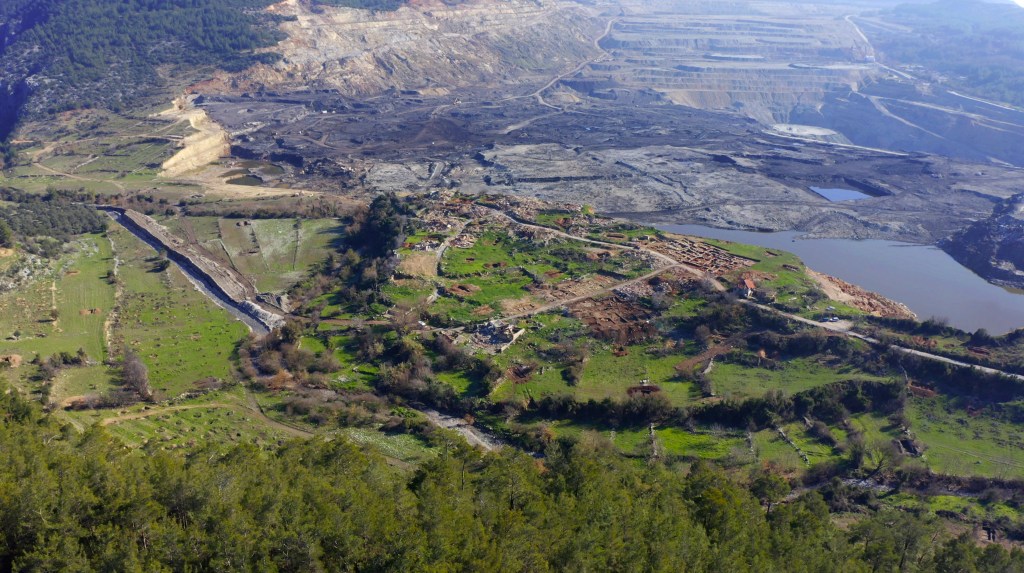
In Turkey, a striking example of forest securitization occurred in Akbelen, where securitization did not mean the “protection” of the forest but its destruction. Located in the southwestern province of Muğla, Akbelen Forest stood at the edge of a coal mine that had operated for more than thirty years, supplying coal to the Yeniköy-Kemerköy thermal power plants. Villagers who had lived in and around Akbelen recount stories of vibrant, idyllic forest-dependent lives: a forest where they foraged herbs and mushrooms, a river where women washed their clothes, and a safe space where young people visiting from the cities found a rare sense of freedom.1 Since the early 1980s, publicly owned energy companies had gradually encroached upon village lands and forests, contributing to the piecemeal dismantling of village life, the resettlement of villagers in nearby areas or cities, and the transformation of some villagers into wage laborers disconnected from their previous subsistence-based livelihoods.2
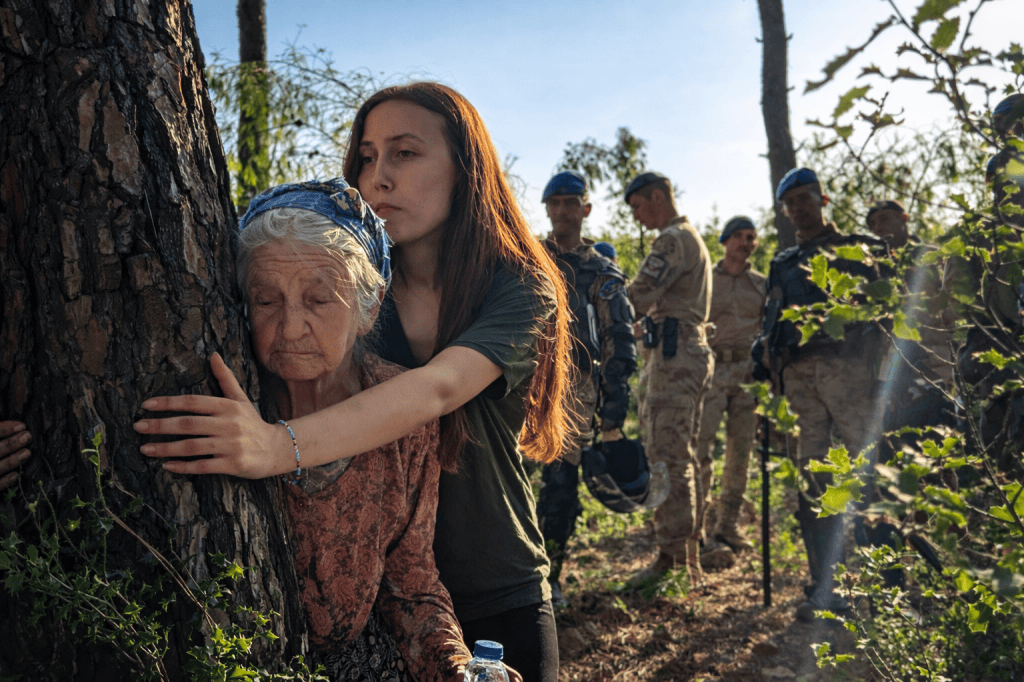
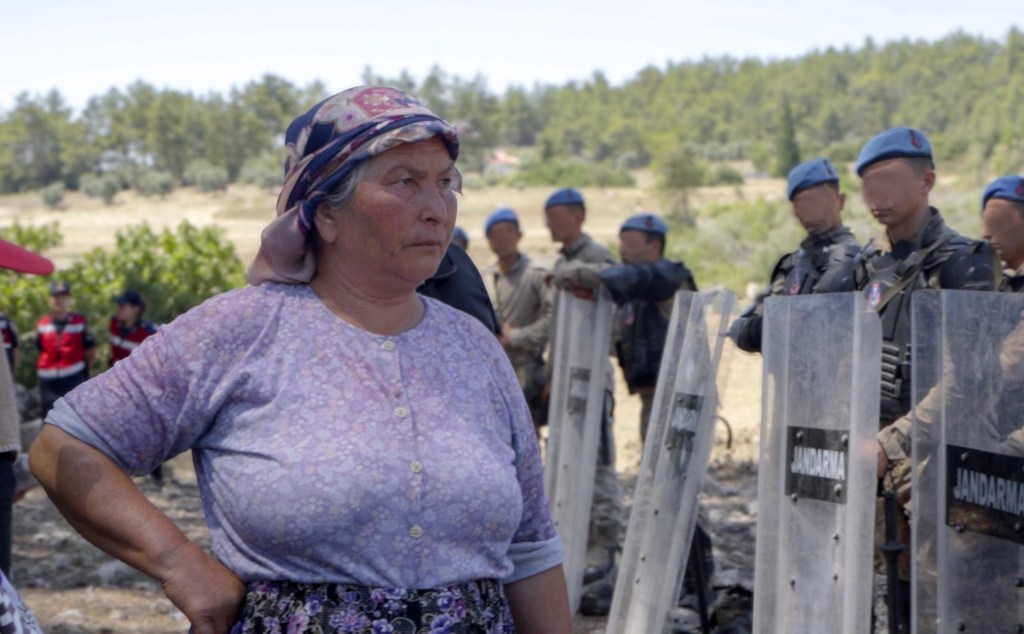
Photo 2. Esra Işık (29) and Zehra Nine (88). Photo 3. Edibe, an Akbelen villager in 2023, after the felling started. Photographed by Selen Çatalyürekli.
In 2020, when the recently privatized energy company sought to expand its operations into the remaining patches of Akbelen Forest, threatening further displacement, groundwater pollution, and the destruction of forest-dependent ways of life, villagers began their resistance. They set up tents, hosted ecology activists from across the country, and, with women taking leading roles in the resistance, explained to the public what the forest meant to them. From their perspective, the forest was not merely a source of livelihood, but a holder of collective memory, a multispecies collective that taught them humility and grounded them in place, an everyday shelter that offered respite from household responsibilities, and a relationship of care and co-becoming that shaped their identities as villagers (Düzel forthcoming).
If security can mean ecological resilience (McDonald 2018), care (Harrington and Shearing 2017), or communal solidarity (Bendfeldt and Basham 2025), as proposed within emerging approaches to “ecological security,” the relationships that villagers cultivated with Akbelen Forest can be understood as practices of security in their own right. These practices were grounded in care, reciprocity, resilience, and collective belonging. Similar relationships have been documented among forest-dependent communities elsewhere, where everyday practices of care and solidarity sustain socioecological worlds even as they are threatened or disrupted by extractive regimes (Bresnihan and Millner 2023).
Yet the forms of security that villagers cultivated through their relationships with the forest were not those recognized by the state. In the language of national energy security, the resource to be protected in Akbelen was not the forest but the coal that sustained the nation’s energy sovereignty. The “public good” demanded “green sacrifice” (Lassila 2025), as defined and implemented through the collaboration of state and private actors. This prioritization of extractive interests was further institutionalized through a July 2025 amendment to Turkey’s Mining Law, which facilitated mining in forests and olive groves, including areas surrounding the Yeniköy-Kemerköy thermal power plants, while weakening environmental oversight and public participation (Erkuş et al. 2025). The villagers, on the other hand, contrasted coal with olive trees – coal use was unsustainable and polluting, offering only short-term energy gains, while the olive trees offered permanence, collective flourishing, and security for future generations. Despite the carnivalesque forms of protest employed in Akbelen, in 2023, security forces were dispatched to the forest to facilitate tree felling and remove protesters. In the following days, state actors and nationalist media portrayed the villagers, particularly the women leading the resistance, as “vandals” and “traitors” who disrupted the national order (Duvar 2023), constituting a continuity of criminalization of ecology defenders and rendering local people as threats to the national order to reinforce territorial control (Oguz 2025; Kurtiç 2022). As a result of a dramatic rise in tensions between the state officers and the villagers, Esra Işık, one of the leading youth voices among villagers, was detained and remained imprisoned for forty-one days.
The presence of heavily armed security personnel, forceful removal of the villagers and ecology activists from the forest, followed by the establishment of a makeshift gendarmerie post at the former protest site, and eventual imprisonment of a young villager woman fundamentally altered the villagers’ relationship with the forest and the state.3 In Akbelen, the securitization of energy supplies and the framing of environmental resistance as a threat to national interests worked together to justify the militarization of the forest. What was secured was not the forest itself, but the continuation of extractive activities in the name of national energy sovereignty. The forest became a site where one understanding of security gained the authority to undermine another.
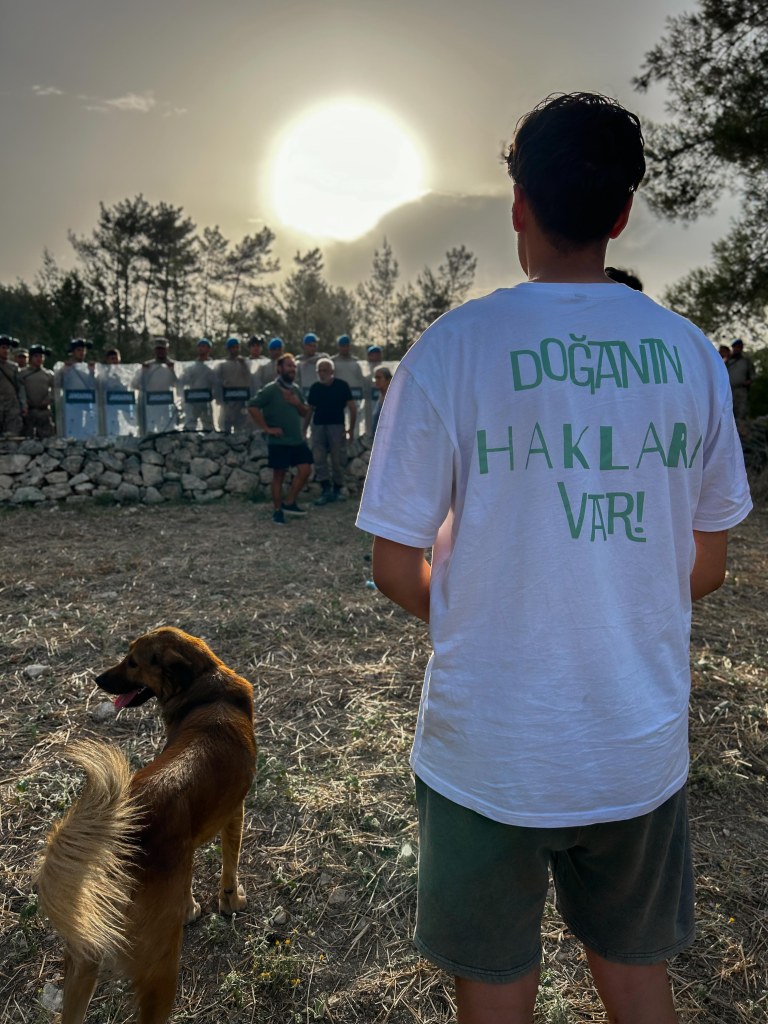
Photo 4. Activists facing the security forces during the felling. Photographed by Selen Çatalyürekli.
The securitization of Akbelen is hardly an isolated phenomenon. Political ecologists and critical conservation scholars have long documented how forests become sites where environmental protection, territorial control, and national security converge. Anxieties over national security during Cold War insurgencies turned conservation into a means of strengthening state territoriality and militarized forms of protection (Peluso and Vandergeest 2011). More recently, the framing of environmental crimes and conflicts as security threats has justified the growing involvement of military and security personnel in environmental governance (Massé 2020; Massé et al. 2018; Billon and Duffy 2018). Concepts such as “green militarization” (Lunstrum 2014), “green violence” (Büscher and Ramutsindela 2016), and “green security” (Kelly and Ybarra 2016) reveal how environmental protection can become entangled with territorial control, the suppression of insurgencies, and the designation of Indigenous, minority, or forest-dependent communities as security risks.
Such interventions often further marginalize already vulnerable communities (Iordăchescu and Vasile 2023), disrupt socioecological relationships that can provide the foundations for “slow peace” (Lederach 2023), and reproduce colonial “moral topographies” that legitimize militarized conservation as a civilizing mission (Amador-Jimenez et al. 2024).4 Despite growing calls for the demilitarization of conservation (Lunstrum et al. 2025), heightened geopolitical tensions, regional wars, and accelerating ecological crises are increasingly positioning forests as new “green frontiers” (Konczal and Asselin 2025), subject to competing claims of national security, environmental protection, and economic development.

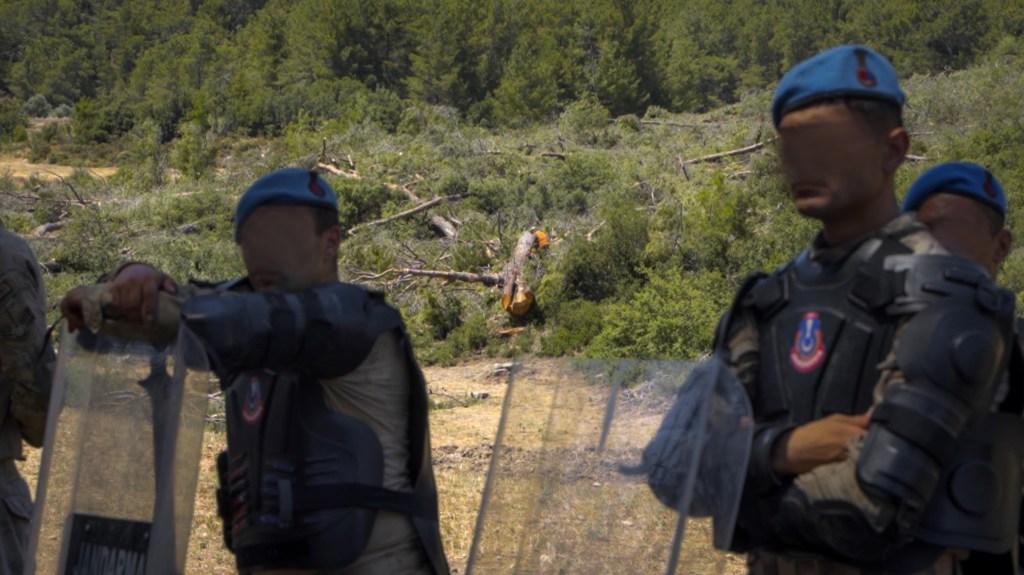
Photo 5. İlkay, an Akbelen villager in 2023, faced with heavily armed gendarmerie. Photo 6. Gendarmerie forces encircled the activists, and behind them construction continued. Photographed by Selen Çatalyürekli.
Akbelen stands as a stark example of forest securitization resulting in destruction rather than protection. Yet it also raises a broader question: Can security be understood and practiced in ways that protect the multispecies relationships through which forest worlds are sustained, allowing them to flourish and remain resilient? Concepts such as ecological security (McDonald 2018), Indigenous intersectional security (Kuokkanen and Sweet 2020), and feminist care-based ecological security (Väyrynen 2023) offer different starting points for rethinking security beyond its dominant geopolitical formulations. They draw attention to well-being, belonging, care, and solidarity, and to the relationships through which security is experienced and sustained.
Rather than treating geopolitical and ecological security as entirely separate domains, attending to forests allows us to examine how different claims to security intersect, compete, and sometimes undermine one another. It also asks us to consider whose security becomes politically recognizable, whose security is rendered expendable, and how particular understandings of security acquire the authority to destroy others. Despite its entanglement with dualistic logics and violent practices, security remains a politically consequential concept: it orders priorities, mobilizes resources, and underpins political legitimacy. It is therefore too important to be left to the language of states and militaries. Thinking it through forests helps us imagine it otherwise.
Endnotes
1 These accounts are based on my interviews with the women villagers in Akbelen and fieldwork visits since 2022, tracing the period of its destruction in 2024. I thank the Ikizköy (the village that is next to the Akbelen forest) village head Nejla Işık for her invaluable support to the research, Deniz Gümüşel for introducing me to the villagers in 2022, and my research partners Ayşe Gül Altınay and Burcu Borhan Türeli for research collaboration and helping me clarify the analysis partially represented in this piece. Selen Çatalyürekli’s photographs reveal much more forcefully the extent of securitization and destruction that happened in Akbelen, than I can do with my words. My sincere thanks go to the women who told me their stories of forest resistance. The research was carried out under the Horizon2020 project ACCTING (Advancing behavioral Change Through an Inclusive Green deal), Grant number 101036504.
2 The detailed examination of the course of events that led to the eventual destruction of the forests and the different ways the activists and the villagers were criminalized can be found here: https://www.sessizkalma.org/en/defender/ikizkoy-akbelen-resistance .
3 Elsewhere, with Batuhan Günşen, we elaborate this point in terms of the changes in Turkish arboreal nationalism under the Justice and Development Party’s rule (Düzel and Günşen, forthcoming).
4 Securitization and militarization are distinct but interconnected processes. I understand securitization as a broader dynamic involving the deployment of security discourses and practices, which may, but do not necessarily, result in militarization.
References
Agamben, Giorgio. 2005. State of Exception. Translated by Kevin Attell. University of Chicago Press.
Amador-Jimenez, Mónica, Pablo Andres Ramos Baron, and Solveig Richter. 2024. ‘Complementary Ways of Seeing “the Nature”: Integrating Varieties of Knowledge Practices in the Management of Local Environmental Conflicts in Colombia’. Environment and Security 2 (1): 47–74.
Bendfeldt, Luise, and Victoria M. Basham. 2025. ‘Beyond the State: Reimagining Protection as Constellations of Care’. Critical Studies on Security 13 (1): 113–16.
Billon, Philippe Le, and Rosaleen V. Duffy. 2018. ‘Conflict Ecologies: Connecting Political Ecology and Peace and Conflict Studies’. Journal of Political Ecology 25 (1): 239–60.
Bresnihan, Patrick, and Naomi Millner. 2023. All We Want Is the Earth: Land, Labour and Movements Beyond Environmentalism. Bristol University Press.
Büscher, Bram, and Maano Ramutsindela. 2016. ‘Green Violence: Rhino Poaching and the War to Save Southern Africa’s Peace Parks’. African Affairs 115 (458): 1–22.
Buzan, Barry, Ole Wæver, and Jaap de Wilde. 1998. Security: A New Framework for Analysis. Lynne Rienner Publishers.
Duvar. 2023. ‘Erdoğan calls activists and villagers in Akbelen Forest “marginals”’. Text. https://www.duvarenglish.com/erdogan-calls-activists-and-villagers-in-akbelen-forest-marginals-news-62857, Duvar English, August 7. https://www.duvarenglish.com/erdogan-calls-activists-and-villagers-in-akbelen-forest-marginals-news-62857.
Düzel, Esin forthcoming. ‘Interview with Nejla Işık and Esra Işık’. Special issue on Ormandaşlık (Forest Companionship). beyond.Istanbul
Düzel, Esin and Hikmet Batuhan Günşen, forthcoming. “From Custodians to Criminals: Forest Communities and the Violence of Arboreal Nationalism in Türkiye” in Arboreal Nationalism in Europe, eds. Jodie Asselin and Damiano Benvegnu. Vernon Press
Erkuş, Hilal, Yavuz Selim Alkan, and Gülşah Tırış. 2025. ‘Energy Democracy, Environmental Justice, and the Governance Gap in the Context of Forest-Based Energy Conflicts: The Case of Akbelen Forest’. Land 14 (9): 1794.
Ferguson, James. 1994. Anti-Politics Machine: Development, Depoliticization, and Bureaucratic Power in Lesotho. U of Minnesota Press.
Harrington, Cameron, and Clifford D. Shearing. 2017. Security in the Anthropocene: Reflections on Safety and Care. Edition Politik, v. 30. Transcipt Verlag.
Iordăchescu, George, and Monica Vasile. 2023. ‘Forests of Fear: Illegal Logging, Criminalization, and Violence in the Carpathian Mountains’. Annals of the American Association of Geographers 113 (9): 2108–25.
Karyotis, Georgios. 2007. ‘European Migration Policy in the Aftermath of September 11: The Security–Migration Nexus’. Innovation: The European Journal of Social Science Research 20 (1): 1–17.
Kelly, Alice B., and Megan Ybarra. 2016. ‘Introduction to Themed Issue: “Green Security in Protected Areas”’. Geoforum 69 (February): 171–75.
Konczal, Agata A., and Jodie Asselin. 2025. ‘“Exploring the Green Frontier within Europe’s Recent Forest Initiatives”’. Geoforum 160 (March): 104242.
Kuokkanen, Rauna, and Victoria Sweet. 2020. ‘Indigenous Security Theory: Intersectional Analysis from the Bottom Up’. In Routledge Handbook of Arctic Security. Routledge.
Kurtiç, Ekin. 2022. Criminalizing Environmental Activism in Turkey. No. 147. Brandeis University, Crown Center for Middle East Studies.
Lassila, Maija Matilda. 2025. ‘Reindeer Herders in the Green Sacrifice Zone: The Cumulative Impacts of Past Extractivist Dispossessions and Recent Mining Expansion in Sodankylä, Finland’. Journal of Political Ecology 32 (1).
Lederach, Angie. 2023. Feel the Grass Grow: Ecologies of Slow Peace in Colombia. 1st edition. Stanford University Press.
Lunstrum, Elizabeth. 2014. ‘Green Militarization: Anti-Poaching Efforts and the Spatial Contours of Kruger National Park’. Annals of the Association of American Geographers 104 (4): 816–32.
Lunstrum, Elizabeth, Francis Massé, Ivan Mugyenzi Ashaba, et al. 2025. ‘Demilitarizing Conservation’. Annals of the Association of American Geographers 115(10): 2525-2537
Massé, Francis. 2020. ‘Conservation Law Enforcement: Policing Protected Areas’. Annals of the American Association of Geographers 110 (3): 758–73.
Massé, Francis, Elizabeth Lunstrum, and Devin Holterman. 2018. ‘Linking Green Militarization and Critical Military Studies’. Taylor & Francis, May 4. World.
Massé, Francis, and Jared D. Margulies. 2020. ‘The Geopolitical Ecology of Conservation: The Emergence of Illegal Wildlife Trade as National Security Interest and the Re-Shaping of US Foreign Conservation Assistance’. World Development 132 (August): 104958.
McDonald, Matt. 2018. ‘Climate Change and Security: Towards Ecological Security? | International Theory’. International Theory 10 (2): 153–80.
Oguz, Zeynep. 2025. ‘When Do Forests Matter?’ Environment and Planning D: Society and Space 43 (6): 962–67.
Peluso, Nancy Lee, and Peter Vandergeest. 2011. ‘Political Ecologies of War and Forests: Counterinsurgencies and the Making of National Natures’. Annals of the Association of American Geographers 101 (3): 587–608.
Väyrynen, Tarja. 2023. Feminist Ecological Pacifism and Care in the Anthropocene. March 22.


Leave a Reply