By: Lily Overacker, masters student at the University of Lethbridge, Alberta, Canada. Lily’s research focuses on the intersections of archival material, folklore, and environment in relation to Sitka Spruce forestry and local communities in Southern Ireland.
My fieldwork in Ireland began in April 2026, although the planning for it began much earlier; some people in my life might argue years earlier when the seeds of this project were first planted. I started learning about North County Cork, where my main field research would take place, and I began to think about Irish folklore and plantation forestry, and what kinds of archival materials I wanted to look for. At first, I was worried: had I planned too much? What if things did not work out? But I realized I had reached the point where it was time to stop thinking about it, and simply embrace the fieldwork and all the possibilities that came with being in a new place, meeting new people, and engaging in this level of research for the first time. I followed my plan, but also left space for spontaneity. I was interested in the historical documentation, narratives of place and people, folklore about forests in my field site, and the nature and content of the material available. I was asking the questions: What makes a forest a forest? How do historical narratives and pieces of folklore converge and/or diverge from contemporary narratives around landscape, folklore, and sense of place? How might this add to our understanding of how people enact and experience place in this region?
An important aspect of this work has been acknowledging the complexity of the term forest, asking if it is the right term when talking about Sitka Spruce plantation forests versus native woodlands, and exploring the various perspectives on the topic. As I reflect on my experiences digging through archives, crawling through “forests” and what it meant to observe from the crossroads, I make more connections between the different layers of this research. The folklore, history, politics, lived experiences, and the changes to the land itself make for a complex reading of how place is constructed and perceived in an area that has gone through massive environmental transformation. In the following paragraphs I offer a small glimpse into the stories shared with me, stories shared over cups of tea, in quiet archives between manuscript pages, and on rainy hikes in the mountains and along narrow forest roads.
My time in Ireland began and ended with archives: hours spent in the Irish National Folklore Collection in Dublin, poring over manuscripts, and searching for mentions of woodlands, trees, forests and other memories from the region I was working in. I went into the archives thinking they would contextualize the places I would do research in and maybe provide some insight into local communities. The longer I spent combing through information and visiting various national-level archives, the more I realized that rather than the archives contextualizing community, I was going to need community to help contextualize the archive. I had so many questions about specific places, tales, and woodlands that often existed as footnotes or passing comments about the region. It was the communities and people I met in North County Cork who often had more detailed accounts of stories, or variations, highlighting different perspectives, and sharing what they thought was most important about the land and how it had changed. Their stories and memories further shaped the way I engaged with the archives again at the end of my trip as I made my way back to Dublin, double checking manuscript stories and gathering materials from suggested sources like Ordnance Surveys and map collections.
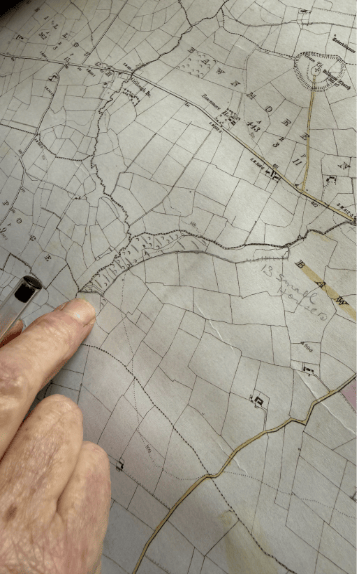
This photo is from an interview where someone is showing me where native woodland used to be and the homes that were once there.
In reflecting on this experience, it highlights how community memory exists as a living archive, in both tangible and intangible ways beyond the pages of the National Folklore Collection or even local libraries. In the tales from local historians who can recollect five hundred years of history, tracing family and landscapes across time, through music and dance at local festivals and ceili’s, in walking across farmland, bogs, and woodlands. It is when stories and knowledge from archives and community come together that depth is created and a better understanding of people’s relationship to place and land emerges.
As for crawling through “forests,” I wish I could say I was joking, when I reflect on the fact that one of the first times, I explored the interior of a Sitka Spruce plantation forest I fell about four feet down the dike around the outside, hands first, as I was attempting to exit. One wrong step and I was on the ground with my wonderful guide standing above me asking if I was injured. The only thing I was in that moment was embarrassed. Although it was this experience that really made it clear to me how difficult it could be to physically engage with Sitka spruce plantation forests, the space was dark, with long ditches inside forestry, often on hillsides or mountainous areas. During these visits, we were often looking for archaeological sites or buildings that had been enclosed by forestry or “forested over,” searching for landscape clues. Unless paths were already created around or within the forestry, the spaces were often difficult to get into and hard to navigate, even with people who knew their way around the landscape and where to look for specific sites.
However, I did not spend all my time in the Sitka spruce “forests,” one aspect of my work also focused on the last little pieces of native woodland in North County Cork. Finding and understanding these small woodlands meant combining historical information about where they are, a better understanding of their contemporary uses, and the folklore and stories attached to them. This inquiry led me to interview people who had lived in the area their whole lives and had witnessed the area transform and change through time, while also recalling stories from their parents and grandparents. One of the pieces of native woodland, is a well-frequented hiking area, that still has many older oak trees and has been managed by local people for likely hundreds of years. This area also had multiple folk stories attached to it, some I had already heard of through the archive, although some aspects were contested or told differently, deepening my understanding of the land and places within these memories and stories. Through these experiences, I was able to better understand local people’s relationships to the landscape and various views on Sitka spruce forestry, native woodlands, and the regions changing landscape.
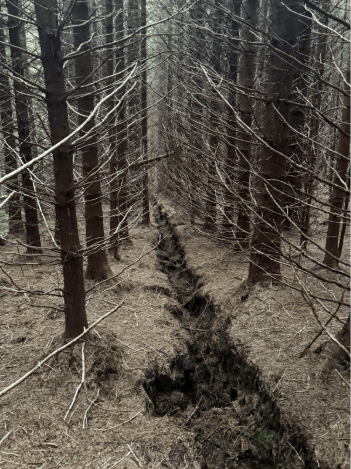
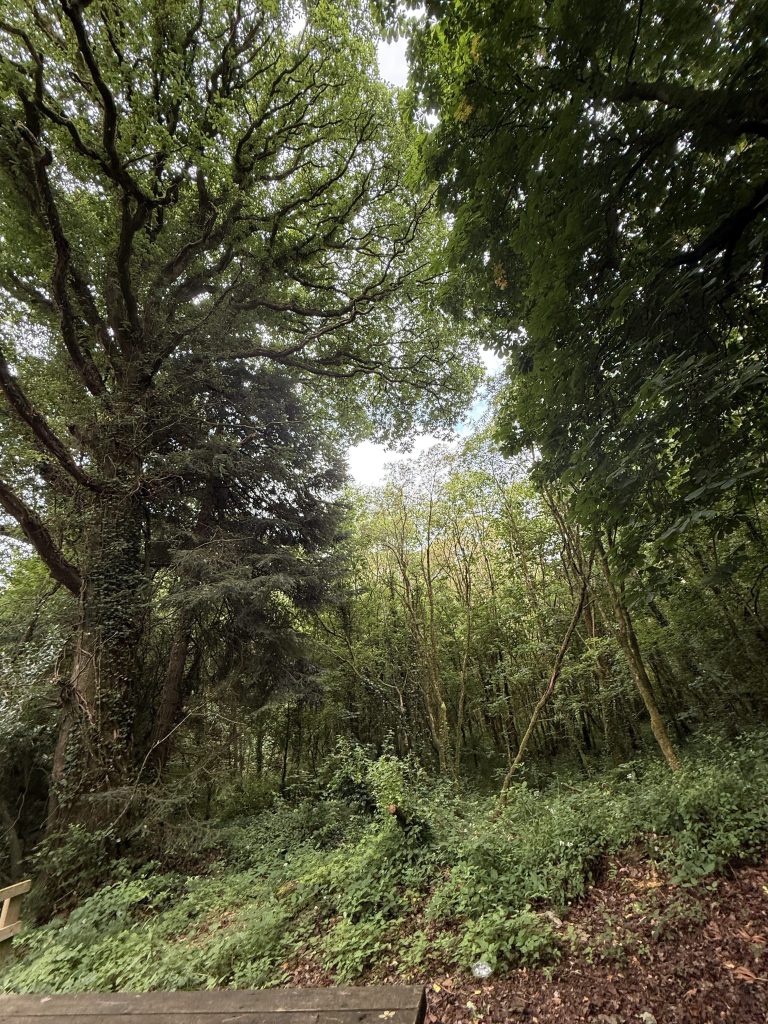
Photo 1. A long ditch/dike inside Sitka Spruce forestry. Photo 2. A patch of native woodland in North County Cork. Taken by author.
When asked where I was coming from, I found myself , “I’m staying above the barbershop, at the crossroads, across from coffee shop.” That was how I situated myself locally to people I was visiting and interviewing. It was the main intersection in town and on a hill, which I never loved parking on, but learned eventually. I found out very quickly that in the small community, there really was only one place to stay for any extended period, so much of the community already knew where I was staying. Living at the crossroads offered a unique opportunity to understand local and rural community life in the summertime. At almost all hours of the day, dairy trucks (or lorries), logging trucks, and tractors passed through the crossroads, just below my apartment. I would be woken up in the morning by the sounds of tractors trying to turn in a crossroads too small for them to turn in, cars backing down the street to make way. In the evening, I would fall asleep to the flashing lights of logging trucks peeking through my blinds as they carried Sitka spruce to their next destination. It became a constant in my fieldwork, observing from the crossroads, sitting at the kitchen table with a cup of tea, while I called around town to people who might be interested in talking to me. When they immediately asked where I was staying, I eventually simplified, saying at the “crossroads in town,” and would hear the reply “oh you’re the girl staying above the barbershop.”
I realized later in my fieldwork that when local people asked if I was staying in the community, it was often them gauging if I had “seen the land for myself,” meaning the overwhelming amount of forestry across the landscape. When I said yes, I received comments about how now I really knew what the land was like and could better understand what was happening on the ground, and they were right. No amount of archival information, history books or stories about the region could fully contextualize the living space of vast forest plantations, long winding rivers, farmland, mountains, bogs, and many other topographical features that would go on to shape the rest of my fieldwork. 
Now here I am, back home in Canada sitting in my favourite coffee shop, answering questions about where I have been for the last months and if my order is still the same. As I reflect on the time I spent digging through archives, crawling through “forests” and what it means to have the opportunity to visit with a community and observe life from the crossroads, of course I think about the material I gathered and how it might be configured into an upcoming thesis. But, maybe even more than the content of the research itself, I continue to reflect on the process of doing this work, the lessons I learned, and the gratitude I feel towards the people, places, and institutions that made it possible. This was not an independent effort, even when I was by myself, I was never truly alone. There was always the archives, the “forests”, the crossroads, and everyone who helped me make sense of the land and attempt to understand their relationship to it.
This research was made possible by the Canadian Social Sciences and Humanities Research Council.


Leave a comment